
What happened
This review from The Guardian, authored by Peter Bradshaw, discusses the new film by Korean director Park Chan-wook, titled "No Other Choice". The film, released on August 29, 2025, is based on Donald E. Westlake's 1997 satirical horror-thriller "The Ax" and is dedicated to Costa-Gavras, who previously filmed it in...
Key Findings and Conclusions:
Plot Summary and Character Analysis:
Korean director Park Chan-wook’s new film brings his usual effortlessly fluent, steely confidence and a type of storytelling momentum that can accommodate all kinds of digressions, set-pieces and the occasional trance-like submission to mysterious visions. It starts out like an Ealing comedy-type caper then somehow morphs into something else: a portrait of family dysfunction, fragile masculinity and the breadwinner crisis, and the state of the nation itself.
It is based on Donald E Westlake’s satirical horror-thriller The Ax from 1997, previously filmed in 2005 by Costa-Gavras, to whom this film is dedicated. It may not be Park’s masterpiece but it is the best film in the Venice competition so far.The scene is a perfect family home, where the man of the house, You Man-su (played by Korean star Lee Byung-hun), is benignly presiding over a late-summer barbecue in the garden, grilling some eels that have been given to him by the new American owners of the paper factory where he is employed.
Adoringly looking on are his wife Miri (Son Ye-jin), her teen son from a previous marriage, their daughter (a cello prodigy), and their two lovely Labradors. But those eels are in fact a heartless and misjudged part of a job payoff; the new US masters are driving through brutal redundancies and Man-su is among them.
He is devastated, but without the emotional language to express or understand how profound this loss is to him. He is fanatically desperate to reclaim his manhood in the eyes of his wife, children and pets by getting a new job in the paper industry within the three months before his severance pay runs out.
But that is impossible, so a brilliant idea occurs to him. He sets up a phoney recruitment ad in a paper industry trade magazine, and with inspired cunning, Man-su makes it clear that, as the head of a paper firm committed to the product, he will on principle accept no online applications; they have to be on paper via the post, thus leaving no digital trail for the crime he intends to carry out.
Using the personal information that these trusting applicants will send him, he will murder them all, thus creating a string of job vacancies in the cases of applicants who are in work, and, in the cases of the unemployed, a reduction in the amount of competition.When asked if he might try employment outside the paper industry, Man-su stubbornly says he has “no other choice”, while the American bosses say they had “no other choice” but to bring down the wage bill.
Now he has “no other choice” but mass murder.At first, this film looks like a serial-killer comedy in the style of Kind Hearts and Coronets, or a salaryman-shame nightmare in the vein of Laurent Cantet’s Time Out and Nicole Garcia’s The Adversary. But in fact Park refuses our expectations: Man-su does not work through his victim-base as we might imagine.
In fact, he stalls early on. Other narrative priorities come to the surface. We discover that the house, which he is in danger of losing due to mortgage default, was his childhood home, and the site of a profound trauma connected to his father, a pig farmer. (One of his victims gets trussed up as compactly as a pig: an unforgettably nasty image.
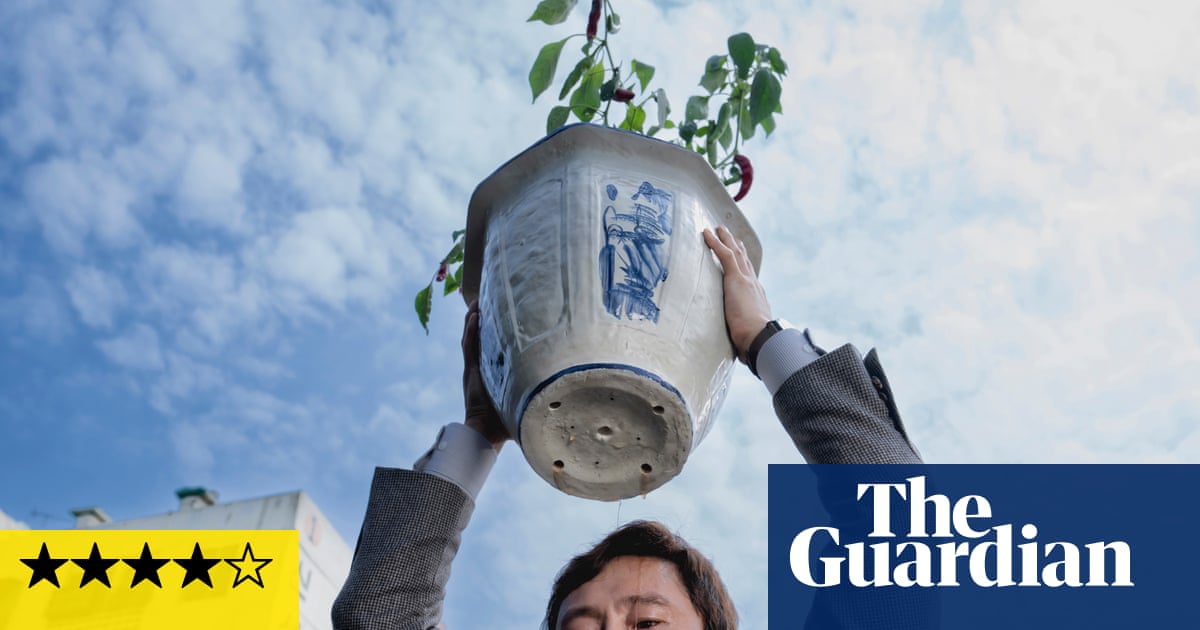
) So all this might be only tangentially connected to his sacking.There are also subplots of family disarray, which loom out of the screen quite as importantly as the bizarre homicide campaign. Miri gets a job as a hygienist, assisting a dentist whom Man-su suspects has designs on her, and he instantly gets a psychosomatic toothache, which he naturally refuses to get treated; the thought of his wife’s suspected lover, assisted by his wife, bending over his open mouth is unthinkable.
Then his son is accused of stealing mobile phones from a store owned by an obnoxious neighbour; and the son also witnesses his dad doing something strange in the greenhouse, which is to be the site of a sensationally weird dream sequence whose pure inexplicability seeps into the rest of the film.And throughout it all, a deadpan note of knockabout black comedy is never entirely absent.
What on earth does it all mean? Some final, extraordinary images of hi-tech paper production and eco-devastation perhaps gesture at a meaning: mechanisation is coming, the algorithm is king, people are less important and our human intentions and human agency are descending into farcical irrelevance.
Source coverage
This review from The Guardian, authored by Peter Bradshaw, discusses the new film by Korean director Park Chan-wook, titled "No Other Choice". The film, released on August 29, 2025, is based on Donald E. Westlake's 1997 satirical horror-thriller "The Ax" and is dedicated to Costa-Gavras, who previously filmed it in...
Key Findings and Conclusions:
Deeper analysis
Full source content
Korean director Park Chan-wook’s new film brings his usual effortlessly fluent, steely confidence and a type of storytelling momentum that can accommodate all kinds of digressions, set-pieces and the occasional trance-like submission to mysterious visions. It starts out like an Ealing comedy-type caper then somehow morphs into something else: a portrait of family dysfunction, fragile masculinity and the breadwinner crisis, and the state of the nation itself.
It is based on Donald E Westlake’s satirical horror-thriller The Ax from 1997, previously filmed in 2005 by Costa-Gavras, to whom this film is dedicated. It may not be Park’s masterpiece but it is the best film in the Venice competition so far.The scene is a perfect family home, where the man of the house, You Man-su (played by Korean star Lee Byung-hun), is benignly presiding over a late-summer barbecue in the garden, grilling some eels that have been given to him by the new American owners of the paper factory where he is employed.
Adoringly looking on are his wife Miri (Son Ye-jin), her teen son from a previous marriage, their daughter (a cello prodigy), and their two lovely Labradors. But those eels are in fact a heartless and misjudged part of a job payoff; the new US masters are driving through brutal redundancies and Man-su is among them.
He is devastated, but without the emotional language to express or understand how profound this loss is to him. He is fanatically desperate to reclaim his manhood in the eyes of his wife, children and pets by getting a new job in the paper industry within the three months before his severance pay runs out.
But that is impossible, so a brilliant idea occurs to him. He sets up a phoney recruitment ad in a paper industry trade magazine, and with inspired cunning, Man-su makes it clear that, as the head of a paper firm committed to the product, he will on principle accept no online applications; they have to be on paper via the post, thus leaving no digital trail for the crime he intends to carry out.
Using the personal information that these trusting applicants will send him, he will murder them all, thus creating a string of job vacancies in the cases of applicants who are in work, and, in the cases of the unemployed, a reduction in the amount of competition.When asked if he might try employment outside the paper industry, Man-su stubbornly says he has “no other choice”, while the American bosses say they had “no other choice” but to bring down the wage bill.
Now he has “no other choice” but mass murder.At first, this film looks like a serial-killer comedy in the style of Kind Hearts and Coronets, or a salaryman-shame nightmare in the vein of Laurent Cantet’s Time Out and Nicole Garcia’s The Adversary. But in fact Park refuses our expectations: Man-su does not work through his victim-base as we might imagine.
In fact, he stalls early on. Other narrative priorities come to the surface. We discover that the house, which he is in danger of losing due to mortgage default, was his childhood home, and the site of a profound trauma connected to his father, a pig farmer. (One of his victims gets trussed up as compactly as a pig: an unforgettably nasty image.
) So all this might be only tangentially connected to his sacking.There are also subplots of family disarray, which loom out of the screen quite as importantly as the bizarre homicide campaign. Miri gets a job as a hygienist, assisting a dentist whom Man-su suspects has designs on her, and he instantly gets a psychosomatic toothache, which he naturally refuses to get treated; the thought of his wife’s suspected lover, assisted by his wife, bending over his open mouth is unthinkable.
Then his son is accused of stealing mobile phones from a store owned by an obnoxious neighbour; and the son also witnesses his dad doing something strange in the greenhouse, which is to be the site of a sensationally weird dream sequence whose pure inexplicability seeps into the rest of the film.And throughout it all, a deadpan note of knockabout black comedy is never entirely absent.
What on earth does it all mean? Some final, extraordinary images of hi-tech paper production and eco-devastation perhaps gesture at a meaning: mechanisation is coming, the algorithm is king, people are less important and our human intentions and human agency are descending into farcical irrelevance.
How this page is built
Goose Pod turns cited reporting into a public episode summary first, then pairs that summary with audio playback so listeners can check the source material before they decide how deeply to engage.
The goal is to make this page useful as a news landing page first, while still giving listeners transcript access, related episodes, and direct links back to the original publishers.