
What happened
This report from New Atlas, authored by Tesla (though the article itself is by New Atlas, referencing Tesla's Optimus), explores the fascinating progression of humanoid robots and their increasing ability to perform complex human movements, particularly dancing. The article, published on August 30, 2025, highlights...
Key Findings and Conclusions:
Key Statistics and Metrics:
We humans have mastered fire, split the atom, and shot ourselves into space. We've built machines that can outthink us and tools that can cook us lunch or cut open our chests to perform life-saving surgeries. That's all well and good. The space part is certainly cool, sure ... but it doesn't look like us.
It doesn't feel human. So what’s the logical next step? Teaching humanoid robots to dance like us, obviously.Dance isn't just our thing either. Birds of Paradise, for example, have mating rituals so intricate and elaborate that people form clubs just to catch a glimpse of the show. The males ruffle their tail feathers and two-step into the hearts of females in an effort to get some action.
Very much like humans.Rare Footage of New Bird of Paradise Species Shows Odd Courtship Dance | Nat Geo WildAnd the Manakin is arguably better at moonwalking than the guy who made it famous, Michael Jackson, while Australia's Peacock Spiders moves are as flashy as their outfits.Even insects are in on dance, though theirs is more math equation than party trick.
The honey bee's "waggle dance" shows which direction to find food relative to the sun – like a fuzzy little booty-shaking Pythagoras. Bee Dance (Waggle Dance)But why robots?"The strongest argument for robots in a human form is that our world is already designed for humans, making it easy for humanoid robots to fit in, adapt to existing environments, and be seamlessly repurposed," says Humanoid, maker of the HMND 1.
Hard to disagree. The humanoid form also makes it easier for us to anthropomorphize our new mechanical friends – for better or for worse. I've personally been moved by a few videos, like one from 1X of its Neo Gamma robot where it just looks absolutely pitiful as it does chores, largely ignored by the humans it serves.
But seeing a humanoid robot dance? That's much more joyful and way more fun ... even if a little freaky. Few things embody the human spirit better than dancing.Dancing animatronics have been around for a long time to entertain us and make us smile. Disney's It's a Small World first debuted at the 1964 New York World's Fair before becoming a permanent Disneyland ride in 1966 – a loop of tiny human-like figures dancing daily via hydraulics and pulleys.
And Chuck E. Cheese's animatronic Pizza Time Players have been making kids cry since 1977.Sixty years later and things are wildly different. Onboard CPUs and GPUs, reinforcement learning (RL), physics engines, proprioception, computer vision with real-time object recognition, SLAM navigation, IMUs with gyros and accelerometers, tactile sensors, microcontrollers, servos, and batteries good for hours of runtime – the list goes on.
One of the earlier mainstream dancing bots segments I remember was in 2005, when Beck's "Hell Yes" video featured a gaggle of Sony QRIO bots cutting loose on the dance floor. For its time, it was nuts. The QRIO (Quest for cuRIOsity) was built for entertainment, stood 2 ft (60 cm) tall, weighed 16 lb (7.
3 kg), and had 38 degrees of freedom (DoF). It could walk, run, jump, and most importantly, dance. They were never sold publicly, and then suddenly scrapped just a year later in 2006.Beck - Hell Yes (Official Music Video)In 2008, Aldebaran Robotics came out swinging with the NAO Robot. It was built for the education sector and found niches in therapy, autism interventions, and STEM.
It stood 22.8 in (58 cm) tall, weighed 11.9 lb (5.4 kg), and had 25 DoF. It was sold mostly to schools and labs and it cost between $7,000 and $15,000 per robot.Though it wasn't entirely open source, it was programmable within certain constraints. Nearly the moment it got into users' hands, the NAO was hacked into a dancing machine using Choregraphe, a drag-and-drop motion sequencer.
Probably the most famous video of them all was the NAO remake of Judson Laipply's "Evolution of Dance."Evolution Of Dance by NAO RobotBy 2017, Toyota showed off its T-HR3 robot – incredibly fluid, even pulling off delicate Tai Chi moves ... but it was teleoperated, mimicking a human in a control suit and VR goggles.
It wasn't fully autonomous, but I included it on this list because it may have been one of the first to reach those levels of human-like fluidity, hinting at what the future may hold.Demonstration of T-HR3 robot by Toyota at iRex17 (part 2 of 2) [RAW VIDEO]Then Boston Dynamics dropped the hammer in late 2020.
Humanity was stuck at home, locked down during the COVID pandemic, when suddenly Spot, Atlas, and Handle were doing the mashed potato, the twist, and a full dance routine to The Contours' 1962 hit "Do You Love Me?" About 42 million people watched, jaws collectively on the floor.The first-generation Atlas – a 4-ft 11-in (1.
5-m), 176-lb (80\-kg), mostly hydraulically powered humanoid robot – moved so well that years later, skeptics still insist it's CGI. It's not. In fact, filming that routine exposed flaws that required Boston Dynamics to make upgrades to Atlas just to pull off the routine. And remember, Atlas was also the first humanoid to land a standing backflip back in 2017.
Do You Love Me?Since then, things have only escalated.Chinese company Unitree burst onto the scene with the G1 – a 4-ft 4-in (1.3-m), 77-lb (35-kg) bot with up to 43 DoF, 3D LiDAR, functioning hands ... and insane athleticism (roboticism?). It was the first humanoid 'bot to do a front flip, the first to backflip without hydraulics, and it can kip-up from its back like a seasoned martial artist.
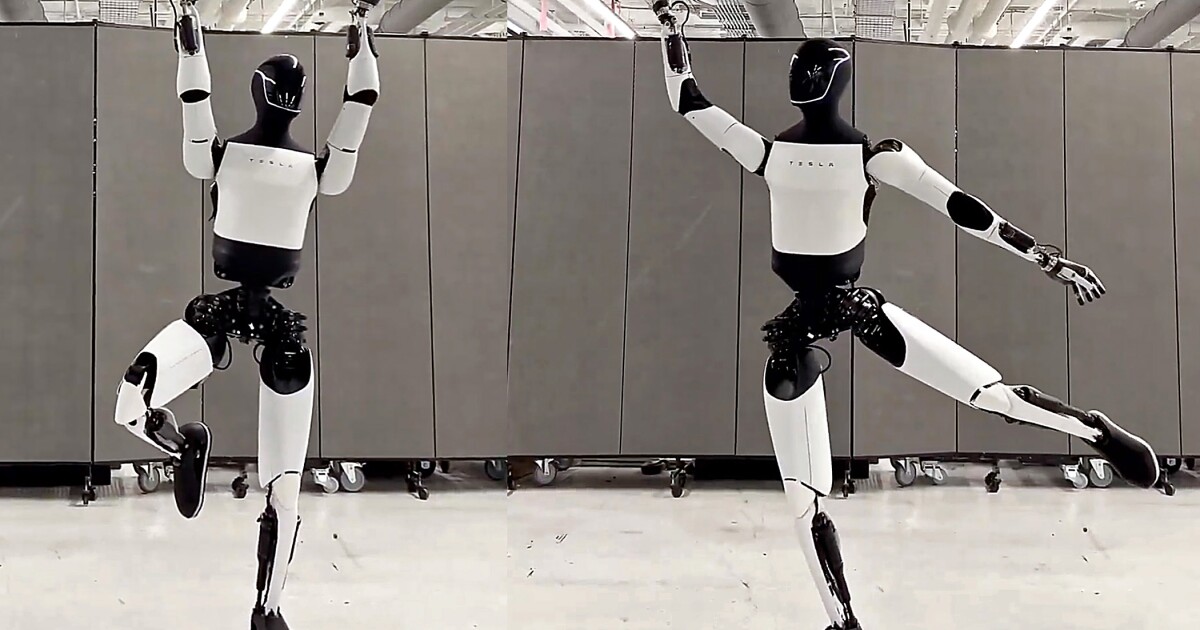
And yes, it dances – better than I do, honestly.What Dance Would You Like to Perform with Unitree G1?But the inspiration for this whole piece was Tesla's Optimus.Milan Kovac, former Tesla VP of Optimus Engineering, posted a clip of Optimus' RL-trained dance moves – "zero-shot" from virtual to real life.
Basically, it learned the choreography in simulation, then nailed it in real life on the first try. That's like imagining yourself dancing Swan Lake while laying on the couch, then standing up and actually doing it.Here's a little more, and no cables this time ;)It's all real-time speed, zero CGI, fully learned in Simulation & zero-shot transferred to real.
Besides the fact that it's fun, we had to make significant improvements to our robot model in Sim, domain randomization and other… https://t.co/Fhnm84vDQE— Milan Kovac (@_milankovac_) May 14, 2025Albeit short, seeing Optimus pull off a basic ballet step floored me. It was the first time I've seen a humanoid robot attempt actual ballet, and it felt like a turning point; a true shift in robotic capabilities.
Huawei did a half-ballet collab back in 2021, but this was on another level.I asked the wifey – who's very much anti-AI and anti-robot – what she thought. Her only words: "Why are we making robots like humans? I don't like it." A sentiment echoed in thousands of comments in these YouTube videos.And yet ...
here we are.From QRIO to Optimus, humanoid robots are literally dancing their way into the cultural spotlight. And these aren't just novelty robots anymore – modern humanoids are highly advanced platforms with hundreds of millions of dollars invested in R&D. Machines that can cost well over $100,000 to make just a single unit.
They have fluidity, balance, and precision that sometimes makes us look clumsy. The fact that we're making these machines waltz, running man, and even plié isn't just about entertainment anymore – it's about testing the limits of motion, of AI, and of human-robot interaction.So maybe teaching robots to dance isn't really the "next step" in technological evolution ...
but it might be the most human one yet.
Source coverage
This report from New Atlas, authored by Tesla (though the article itself is by New Atlas, referencing Tesla's Optimus), explores the fascinating progression of humanoid robots and their increasing ability to perform complex human movements, particularly dancing. The article, published on August 30, 2025, highlights...
Key Findings and Conclusions:
Deeper analysis
Full source content
We humans have mastered fire, split the atom, and shot ourselves into space. We've built machines that can outthink us and tools that can cook us lunch or cut open our chests to perform life-saving surgeries. That's all well and good. The space part is certainly cool, sure ... but it doesn't look like us.
It doesn't feel human. So what’s the logical next step? Teaching humanoid robots to dance like us, obviously.Dance isn't just our thing either. Birds of Paradise, for example, have mating rituals so intricate and elaborate that people form clubs just to catch a glimpse of the show. The males ruffle their tail feathers and two-step into the hearts of females in an effort to get some action.
Very much like humans.Rare Footage of New Bird of Paradise Species Shows Odd Courtship Dance | Nat Geo WildAnd the Manakin is arguably better at moonwalking than the guy who made it famous, Michael Jackson, while Australia's Peacock Spiders moves are as flashy as their outfits.Even insects are in on dance, though theirs is more math equation than party trick.
The honey bee's "waggle dance" shows which direction to find food relative to the sun – like a fuzzy little booty-shaking Pythagoras. Bee Dance (Waggle Dance)But why robots?"The strongest argument for robots in a human form is that our world is already designed for humans, making it easy for humanoid robots to fit in, adapt to existing environments, and be seamlessly repurposed," says Humanoid, maker of the HMND 1.
Hard to disagree. The humanoid form also makes it easier for us to anthropomorphize our new mechanical friends – for better or for worse. I've personally been moved by a few videos, like one from 1X of its Neo Gamma robot where it just looks absolutely pitiful as it does chores, largely ignored by the humans it serves.
But seeing a humanoid robot dance? That's much more joyful and way more fun ... even if a little freaky. Few things embody the human spirit better than dancing.Dancing animatronics have been around for a long time to entertain us and make us smile. Disney's It's a Small World first debuted at the 1964 New York World's Fair before becoming a permanent Disneyland ride in 1966 – a loop of tiny human-like figures dancing daily via hydraulics and pulleys.
And Chuck E. Cheese's animatronic Pizza Time Players have been making kids cry since 1977.Sixty years later and things are wildly different. Onboard CPUs and GPUs, reinforcement learning (RL), physics engines, proprioception, computer vision with real-time object recognition, SLAM navigation, IMUs with gyros and accelerometers, tactile sensors, microcontrollers, servos, and batteries good for hours of runtime – the list goes on.
One of the earlier mainstream dancing bots segments I remember was in 2005, when Beck's "Hell Yes" video featured a gaggle of Sony QRIO bots cutting loose on the dance floor. For its time, it was nuts. The QRIO (Quest for cuRIOsity) was built for entertainment, stood 2 ft (60 cm) tall, weighed 16 lb (7.
3 kg), and had 38 degrees of freedom (DoF). It could walk, run, jump, and most importantly, dance. They were never sold publicly, and then suddenly scrapped just a year later in 2006.Beck - Hell Yes (Official Music Video)In 2008, Aldebaran Robotics came out swinging with the NAO Robot. It was built for the education sector and found niches in therapy, autism interventions, and STEM.
It stood 22.8 in (58 cm) tall, weighed 11.9 lb (5.4 kg), and had 25 DoF. It was sold mostly to schools and labs and it cost between $7,000 and $15,000 per robot.Though it wasn't entirely open source, it was programmable within certain constraints. Nearly the moment it got into users' hands, the NAO was hacked into a dancing machine using Choregraphe, a drag-and-drop motion sequencer.
Probably the most famous video of them all was the NAO remake of Judson Laipply's "Evolution of Dance."Evolution Of Dance by NAO RobotBy 2017, Toyota showed off its T-HR3 robot – incredibly fluid, even pulling off delicate Tai Chi moves ... but it was teleoperated, mimicking a human in a control suit and VR goggles.
It wasn't fully autonomous, but I included it on this list because it may have been one of the first to reach those levels of human-like fluidity, hinting at what the future may hold.Demonstration of T-HR3 robot by Toyota at iRex17 (part 2 of 2) [RAW VIDEO]Then Boston Dynamics dropped the hammer in late 2020.
Humanity was stuck at home, locked down during the COVID pandemic, when suddenly Spot, Atlas, and Handle were doing the mashed potato, the twist, and a full dance routine to The Contours' 1962 hit "Do You Love Me?" About 42 million people watched, jaws collectively on the floor.The first-generation Atlas – a 4-ft 11-in (1.
5-m), 176-lb (80\-kg), mostly hydraulically powered humanoid robot – moved so well that years later, skeptics still insist it's CGI. It's not. In fact, filming that routine exposed flaws that required Boston Dynamics to make upgrades to Atlas just to pull off the routine. And remember, Atlas was also the first humanoid to land a standing backflip back in 2017.
Do You Love Me?Since then, things have only escalated.Chinese company Unitree burst onto the scene with the G1 – a 4-ft 4-in (1.3-m), 77-lb (35-kg) bot with up to 43 DoF, 3D LiDAR, functioning hands ... and insane athleticism (roboticism?). It was the first humanoid 'bot to do a front flip, the first to backflip without hydraulics, and it can kip-up from its back like a seasoned martial artist.
And yes, it dances – better than I do, honestly.What Dance Would You Like to Perform with Unitree G1?But the inspiration for this whole piece was Tesla's Optimus.Milan Kovac, former Tesla VP of Optimus Engineering, posted a clip of Optimus' RL-trained dance moves – "zero-shot" from virtual to real life.
Basically, it learned the choreography in simulation, then nailed it in real life on the first try. That's like imagining yourself dancing Swan Lake while laying on the couch, then standing up and actually doing it.Here's a little more, and no cables this time ;)It's all real-time speed, zero CGI, fully learned in Simulation & zero-shot transferred to real.
Besides the fact that it's fun, we had to make significant improvements to our robot model in Sim, domain randomization and other… https://t.co/Fhnm84vDQE— Milan Kovac (@_milankovac_) May 14, 2025Albeit short, seeing Optimus pull off a basic ballet step floored me. It was the first time I've seen a humanoid robot attempt actual ballet, and it felt like a turning point; a true shift in robotic capabilities.
Huawei did a half-ballet collab back in 2021, but this was on another level.I asked the wifey – who's very much anti-AI and anti-robot – what she thought. Her only words: "Why are we making robots like humans? I don't like it." A sentiment echoed in thousands of comments in these YouTube videos.And yet ...
here we are.From QRIO to Optimus, humanoid robots are literally dancing their way into the cultural spotlight. And these aren't just novelty robots anymore – modern humanoids are highly advanced platforms with hundreds of millions of dollars invested in R&D. Machines that can cost well over $100,000 to make just a single unit.
They have fluidity, balance, and precision that sometimes makes us look clumsy. The fact that we're making these machines waltz, running man, and even plié isn't just about entertainment anymore – it's about testing the limits of motion, of AI, and of human-robot interaction.So maybe teaching robots to dance isn't really the "next step" in technological evolution ...
but it might be the most human one yet.
How this page is built
Goose Pod turns cited reporting into a public episode summary first, then pairs that summary with audio playback so listeners can check the source material before they decide how deeply to engage.
The goal is to make this page useful as a news landing page first, while still giving listeners transcript access, related episodes, and direct links back to the original publishers.