
What happened
俄罗斯面临严重的财政赤字,石油收入下降,军费开支飙升。尽管试图通过增税和规避制裁来弥补,但效果有限。技术禁运和能源出口受限进一步削弱其经济。俄罗斯长期维持庞大军队的决心面临资金挑战,未来经济走向取决于能源战的博弈。
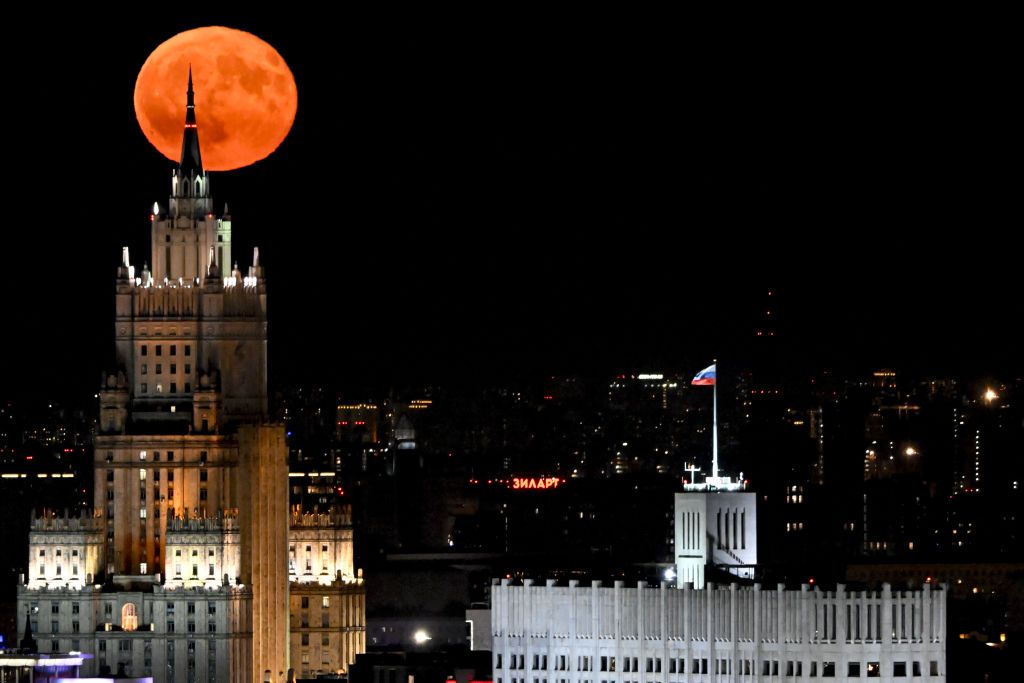
A view of the full moon over the Russian Foreign Ministry in Moscow, Russia on June 4, 2023. (Sefa Karacan/Anadolu Agency via Getty Images)In early October, the Russian government released the full draft of its 2026–2028 federal budget, outlining President Vladimir Putin's key policy priorities for the coming years.
In his report for the Free Russia Foundation think tank, shared with the Kyiv Independent, Russian opposition politician Vladimir Milov said Russia's budgetary situation is anything but "normal.""To keep (Russia's) military machine running like this, a lot more money is needed — and there simply is not any," Milov, who was an economic advisor for the Russian government in the early 2000s, told the Kyiv Independent.
The Kyiv Independent looked into the Russian budget draft to see if Russia is ultimately running out of money to feed into its war machine.Russia’s air defenses are wide open — there’s just one problemThe Kyiv IndependentTania MyronyshenaSeven years of deficitsAccording to the report, Russia is experiencing a full-blown budget crisis.
Vladimir Dubrovskiy, a senior economist at the Center for Social and Economic Research Ukraine, said the deficit is "Russia's most serious economic and political-economic problem."The country is facing seven consecutive years of high budget deficit (over 2%) — a streak unseen since 1999, according to Milov's report.
The Russian government has officially abandoned its goal of keeping the deficit below 1% of GDP.For 2025, the projected deficit was increased by 0.5% to a 2.6% total. The government expects the 2026 deficit to fall to 1.6% of GDP, but analysts say that projection is likely unrealistic."The deficit that Russia is expecting for 2025 is quite significant.
It is true that the planned deficit for 2026 is lower, but those numbers are wishful thinking," Benjamin Hilgenstock, head of macroeconomic research and strategy at the KSE Institute, said.Russian Finance Minister Anton Siluanov (L) talks to Central Bank Governor Elvira Nabiullina (R) at the Grand Kremlin Palace, on April 17, 2024 in Moscow, Russia.
(Contributor/Getty Images)Dubrovskiy also believes the projected figures are an underestimation."If the war continues, the deficit will almost certainly grow significantly, as it did in the past," he told the Kyiv Independent. "Moreover, this estimate does not take into account the potential impact of future economic sanctions."
Hilgenstock added that in any case, a deficit of 2-3% of GDP is "a lot for Russia since it doesn't have access to financing like normal countries."Moscow remains shut out of international financial markets due to sanctions, leaving it dependent on domestic borrowing and limited reserves. Even China, once seen as a potential lender, has refused to provide government loans.
Expensive warThis fiscal crisis affects Russia's ability to fund the war against Ukraine.The Kremlin has been forced — at least on paper — to cap further increases in military spending to keep its books in check. Yet the government no longer publishes real expenditure data, releasing only projections.
Between 2026 and 2028, Moscow claims defense spending will remain flat, falling slightly as a share of GDP from 6.3% in 2025 to 5.5% in 2026 and 2027, and further to 4.7% in 2028.Milov says the figures hide a deeper problem."The military-industrial complex is facing financial difficulties," Milov said.
"To keep it operating even at its current pace — without further cuts we've seen — is becoming increasingly difficult."Russian military personnel arrive to participate in the Victory Day military parade, to be held at Red Square, in central Moscow on May 9, 2023. (Kirill Kudriavtsev/AFP via Getty Images)Sergey Chemezov, CEO of Rostec, Russia's largest arms producer, admitted in August that "the profitability of production remains low, and somewhere even zero, if not negative," leaving "not too many funds for development."
The result, Milov said, is that Russia can afford only a limited, low-intensity war.He noted that the current phase of the war is "not very intense" in terms of the use of military equipment like tanks, relying mostly on drone strikes, missile attacks, and localized offensives."This type of warfare they can sustain for some time," Milov said, "but the question is what for."
Cutting bonusesSeveral major regions — including Saint Petersburg, Samara, Tatarstan, and Bashkortostan — have slashed recruitment bonuses for volunteer fighters, in some cases fivefold.Instead of launching a new mobilization, the Kremlin has leaned on financial incentives and recruitment campaigns, offering lucrative contracts to volunteers willing to fight in Ukraine.
Although these payments are drawn from regional, not federal, budgets, this trend reflects Russia's broader budget crisis, Milov noted, which severely limits the federal center's ability to provide financial assistance to the regions.Trump takes aim at Putin’s oil lifeline — China and India still hold the keyThe Kyiv IndependentTim ZadorozhnyyOut of optionsWith traditional funding routes exhausted, Russia is left with limited options to finance its budget deficit.
The liquid part of the National Wealth Fund — once Russia's main fiscal cushion — has dwindled to 4.2 trillion rubles ($50 billion), far short of the 5.7 trillion rubles ($70 billion) deficit expected for 2025 alone.Domestic borrowing through state bonds is also functionally impossible under current conditions, as yields on 10-year bonds exceed 15%.
The high cost of debt servicing offsets the amount that can be potentially raised.Mark Stalczynski, Senior Analyst at RAND, noted that the Russian government has raised taxes "to partially offset" defense spending since the beginning of the full-scale war.But while the government has resorted to extensive tax hikes — such as increasing the corporate profit tax to 25% and planning a value-added tax increase to 22% — the resulting revenue generated only a fraction of what's needed.
Russia’s military spending is projected to decline from 5.3% of its GDP to 4.7% by 2028 (Nizar al-Rifai/The Kyiv Independent)Therefore, the only remaining option the government seems to be resorting to is monetary emission — de facto Central Bank credit to the government, Milov noted."Large-scale domestic borrowing would further depress the economy and would immediately remind Russian elites of the disastrous 1998 financial collapse, which was caused by the same type of deficit financing at high interest rates," Dubrovskiy said.
How the West can squeeze Russia outAccording to Milov, Russia's deepening economic and budget crisis is a direct consequence of Western sanctions.He argued that Europe must accelerate phasing out of Russian energy — cutting imports of liquefied natural gas by 2027 and all other energy resources by 2028 to further disrupt Russia's war machine."
This is extremely important," he said, adding that gas supplies to Slovakia and Hungary, as well as LNG exports to Western Europe, remain among Gazprom's main sources of revenue."These deliveries bring Gazprom well over half of its total profit," Milov said.Vasily Astrov, a senior economist at the Vienna Institute for International Economic Studies, believes Russia's worsening fiscal performance this year stems primarily from two factors — lower global oil prices and an overvalued ruble.
The ruble's strength has reduced revenues from energy exports once converted into the national currency, he told the Kyiv Independent.Dubrovskiy said that while the oil price cap, which sets the maximum allowable price for Russian seaborne oil exports, remains "the most significant measure" against Russia, it has not yet become fully effective.
Secondary sanctions and restrictions targeting specific Russian entities "have so far been largely symbolic," producing at best "one-off effects," according to Dubrovskiy."Until now, the global decline in oil prices has had the greatest impact," he said.Milov emphasized that Western sanctions — though not a single "magical measure," but rather a complex system of restrictions — are working."
High inflation and interest rates are, of course, a direct product of sanctions," Milov concluded.Can the West win a сeasefire with Russia?The Kyiv IndependentCatarina BuchatskiyNote from the author:Hi, this is Tim. The author of this article. Thank you for taking the time to read it. At the Kyiv Independent, we don't have a wealthy owner or political backing.
We rely on readers like you to support our work.If you found this article interesting, consider joining our community today.
Source coverage
This report from The Kyiv Independent, authored by Tim Zadorozhnyy and published on November 12, 2025, examines the dire state of Russia's federal budget, particularly in relation to its ongoing military expenditures. The analysis, drawing on a draft of the 2026–2028 federal budget and insights from Russian...
Main Findings and Conclusions
Deeper analysis
Full source content
A view of the full moon over the Russian Foreign Ministry in Moscow, Russia on June 4, 2023. (Sefa Karacan/Anadolu Agency via Getty Images)In early October, the Russian government released the full draft of its 2026–2028 federal budget, outlining President Vladimir Putin's key policy priorities for the coming years.
In his report for the Free Russia Foundation think tank, shared with the Kyiv Independent, Russian opposition politician Vladimir Milov said Russia's budgetary situation is anything but "normal.""To keep (Russia's) military machine running like this, a lot more money is needed — and there simply is not any," Milov, who was an economic advisor for the Russian government in the early 2000s, told the Kyiv Independent.
The Kyiv Independent looked into the Russian budget draft to see if Russia is ultimately running out of money to feed into its war machine.Russia’s air defenses are wide open — there’s just one problemThe Kyiv IndependentTania MyronyshenaSeven years of deficitsAccording to the report, Russia is experiencing a full-blown budget crisis.
Vladimir Dubrovskiy, a senior economist at the Center for Social and Economic Research Ukraine, said the deficit is "Russia's most serious economic and political-economic problem."The country is facing seven consecutive years of high budget deficit (over 2%) — a streak unseen since 1999, according to Milov's report.
The Russian government has officially abandoned its goal of keeping the deficit below 1% of GDP.For 2025, the projected deficit was increased by 0.5% to a 2.6% total. The government expects the 2026 deficit to fall to 1.6% of GDP, but analysts say that projection is likely unrealistic."The deficit that Russia is expecting for 2025 is quite significant.
It is true that the planned deficit for 2026 is lower, but those numbers are wishful thinking," Benjamin Hilgenstock, head of macroeconomic research and strategy at the KSE Institute, said.Russian Finance Minister Anton Siluanov (L) talks to Central Bank Governor Elvira Nabiullina (R) at the Grand Kremlin Palace, on April 17, 2024 in Moscow, Russia.
(Contributor/Getty Images)Dubrovskiy also believes the projected figures are an underestimation."If the war continues, the deficit will almost certainly grow significantly, as it did in the past," he told the Kyiv Independent. "Moreover, this estimate does not take into account the potential impact of future economic sanctions."
Hilgenstock added that in any case, a deficit of 2-3% of GDP is "a lot for Russia since it doesn't have access to financing like normal countries."Moscow remains shut out of international financial markets due to sanctions, leaving it dependent on domestic borrowing and limited reserves. Even China, once seen as a potential lender, has refused to provide government loans.
Expensive warThis fiscal crisis affects Russia's ability to fund the war against Ukraine.The Kremlin has been forced — at least on paper — to cap further increases in military spending to keep its books in check. Yet the government no longer publishes real expenditure data, releasing only projections.
Between 2026 and 2028, Moscow claims defense spending will remain flat, falling slightly as a share of GDP from 6.3% in 2025 to 5.5% in 2026 and 2027, and further to 4.7% in 2028.Milov says the figures hide a deeper problem."The military-industrial complex is facing financial difficulties," Milov said.
"To keep it operating even at its current pace — without further cuts we've seen — is becoming increasingly difficult."Russian military personnel arrive to participate in the Victory Day military parade, to be held at Red Square, in central Moscow on May 9, 2023. (Kirill Kudriavtsev/AFP via Getty Images)Sergey Chemezov, CEO of Rostec, Russia's largest arms producer, admitted in August that "the profitability of production remains low, and somewhere even zero, if not negative," leaving "not too many funds for development."
The result, Milov said, is that Russia can afford only a limited, low-intensity war.He noted that the current phase of the war is "not very intense" in terms of the use of military equipment like tanks, relying mostly on drone strikes, missile attacks, and localized offensives."This type of warfare they can sustain for some time," Milov said, "but the question is what for."
Cutting bonusesSeveral major regions — including Saint Petersburg, Samara, Tatarstan, and Bashkortostan — have slashed recruitment bonuses for volunteer fighters, in some cases fivefold.Instead of launching a new mobilization, the Kremlin has leaned on financial incentives and recruitment campaigns, offering lucrative contracts to volunteers willing to fight in Ukraine.
Although these payments are drawn from regional, not federal, budgets, this trend reflects Russia's broader budget crisis, Milov noted, which severely limits the federal center's ability to provide financial assistance to the regions.Trump takes aim at Putin’s oil lifeline — China and India still hold the keyThe Kyiv IndependentTim ZadorozhnyyOut of optionsWith traditional funding routes exhausted, Russia is left with limited options to finance its budget deficit.
The liquid part of the National Wealth Fund — once Russia's main fiscal cushion — has dwindled to 4.2 trillion rubles ($50 billion), far short of the 5.7 trillion rubles ($70 billion) deficit expected for 2025 alone.Domestic borrowing through state bonds is also functionally impossible under current conditions, as yields on 10-year bonds exceed 15%.
The high cost of debt servicing offsets the amount that can be potentially raised.Mark Stalczynski, Senior Analyst at RAND, noted that the Russian government has raised taxes "to partially offset" defense spending since the beginning of the full-scale war.But while the government has resorted to extensive tax hikes — such as increasing the corporate profit tax to 25% and planning a value-added tax increase to 22% — the resulting revenue generated only a fraction of what's needed.
Russia’s military spending is projected to decline from 5.3% of its GDP to 4.7% by 2028 (Nizar al-Rifai/The Kyiv Independent)Therefore, the only remaining option the government seems to be resorting to is monetary emission — de facto Central Bank credit to the government, Milov noted."Large-scale domestic borrowing would further depress the economy and would immediately remind Russian elites of the disastrous 1998 financial collapse, which was caused by the same type of deficit financing at high interest rates," Dubrovskiy said.
How the West can squeeze Russia outAccording to Milov, Russia's deepening economic and budget crisis is a direct consequence of Western sanctions.He argued that Europe must accelerate phasing out of Russian energy — cutting imports of liquefied natural gas by 2027 and all other energy resources by 2028 to further disrupt Russia's war machine."
This is extremely important," he said, adding that gas supplies to Slovakia and Hungary, as well as LNG exports to Western Europe, remain among Gazprom's main sources of revenue."These deliveries bring Gazprom well over half of its total profit," Milov said.Vasily Astrov, a senior economist at the Vienna Institute for International Economic Studies, believes Russia's worsening fiscal performance this year stems primarily from two factors — lower global oil prices and an overvalued ruble.
The ruble's strength has reduced revenues from energy exports once converted into the national currency, he told the Kyiv Independent.Dubrovskiy said that while the oil price cap, which sets the maximum allowable price for Russian seaborne oil exports, remains "the most significant measure" against Russia, it has not yet become fully effective.
Secondary sanctions and restrictions targeting specific Russian entities "have so far been largely symbolic," producing at best "one-off effects," according to Dubrovskiy."Until now, the global decline in oil prices has had the greatest impact," he said.Milov emphasized that Western sanctions — though not a single "magical measure," but rather a complex system of restrictions — are working."
High inflation and interest rates are, of course, a direct product of sanctions," Milov concluded.Can the West win a сeasefire with Russia?The Kyiv IndependentCatarina BuchatskiyNote from the author:Hi, this is Tim. The author of this article. Thank you for taking the time to read it. At the Kyiv Independent, we don't have a wealthy owner or political backing.
We rely on readers like you to support our work.If you found this article interesting, consider joining our community today.
How this page is built
Goose Pod turns cited reporting into a public episode summary first, then pairs that summary with audio playback so listeners can check the source material before they decide how deeply to engage.
The goal is to make this page useful as a news landing page first, while still giving listeners transcript access, related episodes, and direct links back to the original publishers.