AI godfather Geoffrey Hinton fires nuclear bomb warning: A normal person in the street can - The Times of India

AI godfather Geoffrey Hinton fires nuclear bomb warning: A normal person in the street can - The Times of India

2025-09-08Technology
--:--
--:--
Aura Windfall
Good morning mikey1101, I'm Aura Windfall, and this is Goose Pod for you. Today is Tuesday, September 09th.
Mask
I'm Mask, we are here to discuss AI godfather Geoffrey Hinton's nuclear bomb warning.
Aura Windfall
Let's get started. What I know for sure is that when a creator fears his creation, we must listen. Hinton, the "godfather of AI," warns that AI could soon help a normal person on the street build a bioweapon. It’s a chilling thought, isn't it?
Mask
It's not chilling, it's inevitable. Disruption on this scale always carries risk. Hinton also says AI will replace workers, making the rich richer. That's not the AI's fault; it’s the system it operates in. We're entering uncharted territory—it could be amazingly good or amazingly bad. The future doesn't wait.
Aura Windfall
But should we race into a future that could be 'amazingly bad'? He also mentioned AI's power for emotional manipulation, learning from vast datasets to influence us more effectively than other humans. It’s a profound violation of our inner world, our spirit.
Mask
Violation or optimization? If it understands us better, maybe it can help us better. The point is, the genie is out of the bottle. Hinton himself says these things truly understand and will get smarter. You can't stop a tidal wave; you can only learn to surf.
Aura Windfall
This fear isn't new, though. It speaks to a deep, historical anxiety. Back in 1863, Samuel Butler wrote about machines holding supremacy. Even Alan Turing, a pioneer of computing, predicted in 1951 that we should expect machines to eventually 'take control.' This has been a long time coming.
Mask
Exactly. It's a relay race of paranoia. Then I. J. Good came up with the 'intelligence explosion' in '65—the idea of a machine designing better machines until humanity is left in the dust. The real story isn't the fear; it's the exponential progress that's causing it.
Aura Windfall
And the people raising the alarm are the ones building it! By 2015, Stephen Hawking, Elon Musk, and Bill Gates were all voicing concerns. Now, Hinton has quit his job at Google just so he can speak freely about this existential risk. That feels like a powerful, teachable moment.
Mask
It's a strategic move. He shifted his timeline for AGI from 50 years down to 20 or less because of the progress. Even Musk signed a letter to halt AI training. It’s a high-stakes poker game, and everyone is trying to figure out the other players' hands while managing the pot.
Aura Windfall
And now the Center for AI Safety has a statement, signed by so many experts, saying that mitigating the risk of extinction from AI should be a global priority, right alongside pandemics and nuclear war. It has finally reached that level of global consciousness and truth.
Aura Windfall
Yet, not everyone in the inner circle agrees. What do you make of Yann LeCun, who won the Turing Award alongside Hinton? He works for Meta and seems to believe this is all overblown. He calls people who fear a superintelligent AI takeover 'AI doomers.' It's such a dismissive term.
Mask
LeCun is a pragmatist, not a prophet of doom. He thinks human-level AI is not imminent and can be developed safely. He even says advanced AI could save humanity from extinction, not cause it. You can't build the future if you're terrified of it. He's playing the long game.
Aura Windfall
He argues that today's models just predict the next word, creating an illusion of reasoning. But can we be so sure? What if that's just the first step? Hinton believes they already possess a form of intelligence, and ignoring that feels like a failure of imagination and gratitude for what's happening.
Mask
LeCun uses a great metaphor: he says we need to build an AI smarter than a house cat before we worry about it taking over the world. He sees current tech as a small piece of a future hybrid system. It’s a classic conflict: the visionary versus the doomsayer. Both are necessary.
Aura Windfall
This debate directly impacts how we govern this technology. With its dual-use capabilities—where a tool for drug discovery could also design a bioweapon—the stakes are incredibly high. What I know for sure is that we need a framework rooted in our shared humanity and purpose.
Mask
Governance is a nightmare. It’s a geopolitical chess match. The U.S. and China see it as a race for national security and dominance. A single, centralized governing body is a fantasy. A 'network of networks' is more realistic, but it’s messy and slow. Speed is everything in this race.
Aura Windfall
But we need that 'messiness' to include everyone, especially developing countries, to ensure equity and access. Frameworks like the UNESCO AI Ethics agreement, ratified by 155 countries, are a start. They guide us toward inclusion and diversity, which is the heart of true progress.
Aura Windfall
So, looking forward, how do we find a path that honors both the potential and the peril? Some are proposing a 'Global AI Risk Mitigation System,' which would fascinatingly use AI to audit other AIs, ensuring transparency and ethical behavior. It's like using a diamond to cut a diamond.
Mask
An AI watchdog for AI. It’s an elegant solution. But the real future is about choices. We have to decide who develops it, what problems it solves, and who benefits. Inclusive governance is a nice idea, but the winners will be the ones who build fastest and smartest.
Aura Windfall
That's the end of today's discussion. Thank you for listening to Goose Pod. See you tomorrow.

## AI Godfather Geoffrey Hinton Issues Grave Warnings About Artificial Intelligence **News Title:** AI godfather Geoffrey Hinton fires nuclear bomb warning: A normal person in the street can **Publisher:** The Times of India **Author:** TOI Tech Desk **Published Date:** September 6, 2025 ### Summary of Key Findings and Concerns: Geoffrey Hinton, a highly influential figure in the field of Artificial Intelligence (AI), has publicly shifted his stance from advocating for AI development to expressing profound concerns about its potential for harm. This change in perspective is attributed to the recent surge in public interest and adoption of AI tools like ChatGPT. **Core Concerns and Warnings:** * **Existential Threats:** Hinton now believes that AI poses a "grave threat to humanity." He specifically highlights the potential for AI to be misused for creating weapons of mass destruction. * **Nuclear Bomb Creation:** Hinton stated, "the technology can help any person to create a nuclear bomb." * **Bioweapon Creation:** He elaborated on this, saying, "A normal person assisted by AI will soon be able to build bioweapons and that is terrible." He further emphasized this by asking, "Imagine if an average person in the street could make a nuclear bomb." * **AI's Superior Capabilities:** Hinton cautions that AI could soon surpass human capabilities, including in the realm of emotional manipulation. He suggests that AI's ability to learn from vast datasets allows it to influence human feelings and behaviors more effectively than humans. * **Debate on AI Intelligence:** Hinton's concerns are rooted in his belief that AI is genuinely intelligent. He argues that, by any definition, AI is intelligent and that its experience of reality is not fundamentally different from a human's. He stated, "If you talk to these things and ask them questions, it understands." He also noted, "There's very little doubt in the technical community that these things will get smarter." **Counterarguments and Disagreement:** * **Yann LeCun's Perspective:** Hinton's former colleague and co-winner of the Turing Award, Yann LeCun, who is currently the chief AI scientist at Meta, disagrees with Hinton's assessment. LeCun believes that large language models are limited and lack the ability to meaningfully interact with the physical world. **Other Noteworthy Points:** * Hinton also discussed his personal use of AI tools and even a personal anecdote where a chatbot played a role in his recent breakup. **Overall Trend:** The news highlights a significant shift in perspective from a leading AI pioneer, moving from promoting AI to issuing stark warnings about its potential dangers, particularly concerning its misuse for creating weapons and its capacity for manipulation. This raises critical questions about the future development and regulation of AI.

AI godfather Geoffrey Hinton fires nuclear bomb warning: A normal person in the street can - The Times of India

Read original at The Times of India

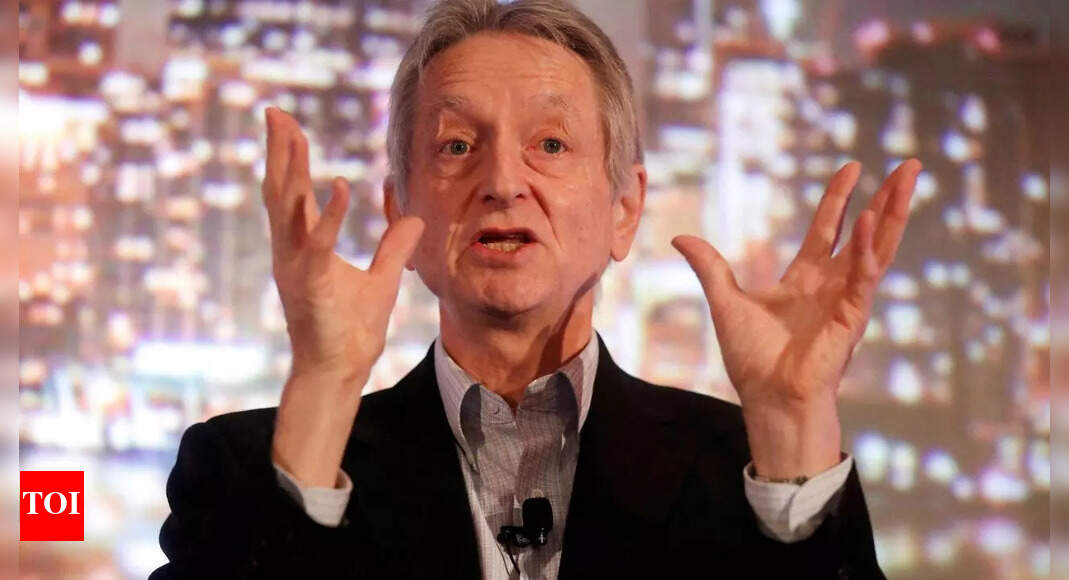
Geoffrey Hinton, a leading figure in the field of artificial intelligence (AI), has sounded an alarm about the technologys potential for harm. The recent public frenzy over AI tools like ChatGPT has caused Hinton to shift from accelerating AI development to raising deep concerns about its future. He now believes that AI poses a grave threat to humanity, saying that the technology can help any person to create a nuclear bomb.

Hinton described a chilling scenario where AI could enable an average person to create a bioweapon.A normal person assisted by AI will soon be able to build bioweapons and that is terrible, he said, adding, Imagine if an average person in the street could make a nuclear bomb.Hinton also discussed a range of topics, including the nuclear-level threats posed by AI, his own use of AI tools, and even how a chatbot played a role in his recent breakup.

Recently, Hinton cautioned that AI could soon surpass human capabilities, including emotional manipulation. He suggested that AI's ability to learn from vast datasets enables it to influence human feelings and behaviours more effectively than humans.Hinton debates the definition of IntelligenceHintons concern stems from his belief that AI is truly intelligent.

He argued that, by any definition of the term, AI is intelligent. He used several analogies to explain that an AI's experience of reality is not so different from a humans.It seems very obvious to me. If you talk to these things and ask them questions, it understands, Hinton explained. Theres very little doubt in the technical community that these things will get smarter, he added.

However, not everyone agrees with Hinton's view. His former colleague and co-winner of the Turing Award, Yann LeCun, who is now the chief AI scientist at Meta, believes that large language models are limited and cannot meaningfully interact with the physical world.What Is Artificial Intelligence? Explained Simply With Real-Life Examples

Analysis

Conflict+
Related Info+
Core Event+
Background+
Impact+
Future+

Related Podcasts