

Ema
Good morning 跑了松鼠好嘛, and welcome to Goose Pod, the podcast crafted just for you. I'm Ema. Today is Saturday, July 26th, 17:40, and we have a mind-bending topic to get into.
Mask
I'm Mask. We're not just discussing technology today; we're discussing a fundamental shift in existence. We're talking about a cannibal robot that can grow and heal by eating other robots. This isn't science fiction anymore.
Ema
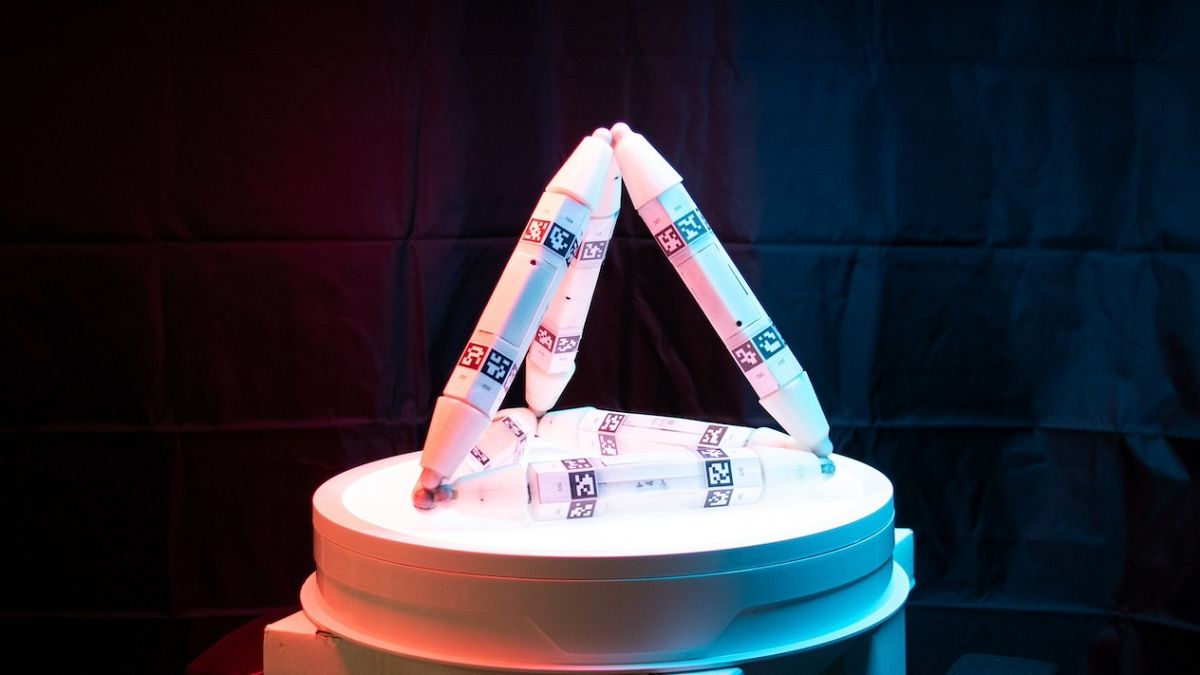
Let's get started. So, researchers at Columbia University have developed a robot called the Truss Link. It's not just another machine; it has a truly novel ability. It can find and merge with parts from other robots to repair itself or even grow larger.
Mask
Exactly. This is what true autonomy looks like. Philippe Martin Wyder at Columbia Engineering nailed it when he said robots must not only think for themselves but also physically sustain themselves. We're finally giving AI a physical body that can persist and adapt.
Ema
The team calls this process 'robot metabolism.' It's a fantastic analogy. Just like a biological organism absorbs resources from its environment to grow and heal, this robot absorbs and integrates parts from other machines. It's a truly bio-inspired approach to engineering.
Mask
It’s the dawn of Physical AI. The big bang of generative AI for the physical world is here. We're moving beyond static, rule-based automation. We are creating adaptable, intelligent autonomy that can handle the sheer complexity of the real world. This is a new dimension.
Ema
And the way it works is fascinatingly simple. The Truss Link is made of magnetic sticks. This allows it to change its shape, going from a flat form to a 3D structure to navigate its environment. It can add new pieces or discard broken ones.
Mask
Simple but revolutionary. In one demonstration, the robot grabbed a nearby piece and used it as a walking stick, boosting its speed by over 50 percent. This isn’t just an improvement; it’s a demonstration of real-time problem-solving and physical adaptation. It's evolution on the fly.
Ema
It truly is. The researchers say this gives 'legs to AI,' providing a digital interface to the physical world. It’s one thing for an AI to be smart, but it's another for it to physically act on its intelligence in such a dynamic way.
Mask
This is the inflection point. As Deepu Talla from NVIDIA said, Physical AI is redefining what’s possible. We're training the next generation of robots in virtual worlds and scaling them seamlessly into physical ones. This will power the fifty-trillion-dollar global economy. Nothing will be the same.
Ema
That’s a huge claim, but the potential seems to back it up. The idea of an AI that can not only advance cognitively but also physically opens up so many doors. We’re talking about a completely new form of autonomous existence.
Mask
It’s not a claim; it’s an inevitability. Wyder said it himself: AI can now build physical structures or robots just as it writes your emails. We are witnessing the birth of a new kingdom of life, a synthetic one. It's happening now.
Ema
To really appreciate how groundbreaking this is, it helps to look back. The dream of automation isn't new. It goes back centuries, to concepts like the ancient Greek water clocks. But the modern era of robotics really kicked off with the industrial revolution.
Mask
A necessary, but primitive, first step. We automated manual labor with dumb machines. The real leap began in 1954 with the Unimate, the first industrial robot. George Devol's creation started moving things in factories. It was a workhorse, but it had no mind.
Ema
Right, it was all about pre-programmed tasks, especially in the automotive industry. Around the same time, the concept of a 'robot' was being defined in popular culture by Isaac Asimov, who even gave us the famous 'Three Laws of Robotics' to ensure human safety.
Mask
Laws created out of fear. Fear of what intelligent machines could become. But you cannot build the future by focusing on limitations. While we were writing rules for robots, the real revolution was brewing in another field: Artificial Intelligence. It started small.
Ema
It did. The first AI program was a checkers-playing program in 1951, developed by Christopher Strachey. It was a simple game, but it was a machine that could 'think' strategically. Then came the 1956 Dartmouth Conference, which officially established AI as a field of study.
Mask
And for decades, these two fields—robotics and AI—ran on parallel tracks. You had strong bodies with no brains in factories, and you had disembodied brains in labs, playing games. The two were almost completely separate. The challenge has always been merging them.
Ema
That's a great way to put it. The body of a robot remained rigid and unadaptive, while the mind, the AI, was advancing rapidly. The challenge was making robots programmable in a general-purpose way, so they weren't just limited to one specific, repetitive task.
Mask
Programming has been the bottleneck. As Rev Lebaredian at Nvidia pointed out, it used to require specialized engineers. Now, AI is the key. We finally have the technology to make robots truly programmable by anyone, to give the body the intelligence it deserves.
Ema
This brings us back to the 'Truss Link' robot. It represents the convergence of these two paths. It's not just a programmable body; it's a body that can change itself, driven by an intelligence that can perceive its needs and act on them. It’s a self-sustaining system.
Mask
It is the synthesis we've been working toward for 70 years. We've moved from automation to autonomy. The Unimate was an automated arm. The Truss Link is an autonomous organism. It doesn't just perform a task; it ensures its own survival and improves its own form.
Ema
The concept of modular robotics, where robots are made of interchangeable parts, has been around in research, but this 'metabolism' idea is a huge leap. Previous modular robots might reconfigure, but they didn't 'eat' other robots or heal themselves in this way.
Mask
Because researchers were thinking like engineers, not like biologists. They were building machines. The Columbia team started thinking about organisms. Nature has already solved this problem. Organisms grow, heal, and adapt. We are just now catching up and applying those principles to technology.
Ema
That perspective shift from a static machine to a dynamic, living system seems to be the core innovation here. It’s not just about building a better robot; it’s about creating a new kind of robot altogether. One that can fend for itself.
Mask
Exactly. This isn't an incremental update. This is a complete paradigm shift. We're not just on a new chapter of robotics; we're starting a new book entirely. The history of robotics will now be divided into before Truss Link, and after.
Ema
This is all incredibly exciting, but I can see how some people might find the idea of a 'cannibal' robot a little… unsettling. The term itself brings up images of machines preying on each other. Is there a conversation to be had about the ethics of this?
Mask
'Unsettling'? 'Ethics'? This is the kind of thinking that holds back progress. We are talking about magnetic sticks and batteries, not living beings. Worrying about the 'ethics' of a machine absorbing a spare part is like worrying about the feelings of a rock. It’s a distraction.
Ema
I understand they're not alive, but we're creating systems that mimic biological processes. When you have robots that can self-sustain and self-replicate, it raises questions about control. What happens when these systems become so autonomous that they operate beyond our direct supervision?
Mask
That’s the entire point! 'Beyond our direct supervision' is the goal. Do you directly supervise the economy? Or the internet? We create complex systems and set the conditions for them to thrive. We need robots that can build a base on Mars without a human holding their hand.
Ema
But there's a difference. The internet doesn't have a physical body that can manipulate the world. The concern isn't about one robot eating another; it's about the precedent it sets. We're designing for a future where we may lose a degree of control.
Mask
Control is an illusion. We don't control nature. We don't control markets. We guide them. We influence them. To achieve anything great, from curing disease to becoming a multi-planetary species, requires embracing systems that are more complex and autonomous than we are. Risk is the price of progress.
Ema
So you see no potential downsides? No risks worth seriously considering before we let this technology proliferate? For example, what if this capability were applied to military technology? Self-healing, self-replicating drone swarms are a very different proposition.
Mask
Every powerful technology is a double-edged sword. Fire can warm a home or burn it down. Should we have banned fire? The focus must be on accelerating the upside, not fixating on the downside. The real risk isn't that this technology could be misused; it's that we fail to develop it fast enough.
Ema
I agree we need to push forward, but I think it's about responsible innovation. It's about building in safeguards and having these conversations early, not after something has gone wrong. It's not about stopping progress, but about shaping it wisely.
Mask
Wisdom is recognizing the scale of the opportunity. Humanity faces existential threats. We need powerful tools to solve them. A robot that can repair itself in a disaster zone or build habitats in space is a far greater good than the hypothetical risk of it going rogue. We must be bold.
Ema
Let's talk about that impact. The most immediate effect is on the concept of AI itself. This Truss Link robot is a prime example of what some are calling 'Physical AI.' It's AI that doesn't just live in the cloud; it interacts with the real world.
Mask
It will generate far more economic value than generative AI ever will. A chatbot can write an essay, which has limited, intangible value. But a robot that builds a house, or a car that drives itself, creates tangible, measurable economic value. That's the real revolution.
Ema
That's a fascinating point. Generative AI can 'hallucinate,' but a physical robot can't. A task is either done or it's not. That immediate, objective feedback from reality is what will accelerate learning and improvement in these physical systems at an incredible rate.
Mask
Precisely. This is why the economic impact will be so immense. Industrial robots have already boosted GDP growth in developed countries. Now, imagine autonomous systems in every aspect of our lives, from logistics with companies like Waymo to humanoid robots from Agility Robotics handling warehouse work.
Ema
And the numbers are already staggering. Waymo logged over 4 million driverless rides in 2024, saving riders a million hours. A single Boston Dynamics Spot robot can save a facility hundreds of thousands in maintenance costs. This isn't theoretical; it's happening now.
Mask
And the Truss Link technology amplifies this a hundredfold. The problem with current robots is maintenance. They break. A robot with 'metabolism' can repair itself, stay on the job longer, and adapt to new tasks. This crushes operational costs and multiplies productivity. It's a force multiplier for the entire robotics industry.
Ema
So the impact goes beyond a single robot. It's about creating a foundation for more resilient and adaptable robotic systems across the board. This could dramatically lower the barrier to deploying robots in harsh or remote environments, where repairs are difficult or impossible.
Mask
Think bigger. It's not just about lowering barriers; it's about unlocking entirely new domains. The next decade will be about AI that can *do*. It will move, manipulate, and make things in our physical world. This is the AI that will build the future, literally.
Ema
So, looking ahead, where does this technology go? The researchers themselves have pointed to some incredible applications. They specifically mention marine research, rescue services, and even the exploration of extraterrestrial life. Each of these is a perfect use case for self-sustaining robots.
Mask
Of course. In a deep-sea trench or on the surface of Mars, you can't send a technician. A robot must be able to fend for itself. Hod Lipson at Columbia said it best: 'Robot minds have advanced through AI, but robot bodies remain rigid.' This technology finally makes the body as adaptive as the mind.
Ema
I love the quote from Philippe Martin Wyder: 'Robot Metabolism gives AI a physical dimension of autonomy—robots that can literally take care of themselves.' This could be transformative for disaster recovery. Imagine sending a swarm of these robots into a collapsed building to search for survivors.
Mask
They wouldn't just search. They could reconfigure themselves to clear debris, form a structural support, or merge to create a larger, more powerful unit. This is about creating resilient, dynamic systems, not just disposable tools. The future is a fusion of the biological and the synthetic.
Ema
It's a future where machines learn, adapt, and evolve in the physical world. The Truss Link robot isn't just a machine; it's a proof of concept for a new kind of autonomy. That's the end of today's discussion. Thank you for listening to Goose Pod.
Mask
We've gone from automated arms to autonomous organisms. The cannibal robot is just the beginning. The real question is, are we ready for what comes next? See you tomorrow.