

What happened
Publisher: Asia Times
Author: David Kirichenko
Publication Date: August 7, 2025 (reporting from the war front)
When Russia launched its full-scale invasion of Ukraine in February 2022, Ukrainians across the globe mobilized to defend their homeland. Some picked up weapons while others contributed with their technical abilities. Now in a fourth year of fighting, Ukraine’s wartime resilience endures, thanks in large part to volunteers and tech pioneers who have raced to out-innovate Russia on the battlefield.
Among them is Lyuba Shipovich, a software engineer and tech entrepreneur who had been running a tech company in New York City. She left the United States and returned to Ukraine at the beginning of Russia’s full-scale invasion to join the resistance. By 2023, she founded Dignitas, a nonprofit dedicated to training Ukrainian soldiers and integrating cutting-edge technologies into Ukraine’s military operations.
Dignitas has already spearheaded major initiatives like Victory Drones, a drone-training outfit for the military, civilians and producers, and helped drone operators scale across Ukraine’s army. Now, Shipovich is turning her focus to ground robotics, working to ensure Ukraine’s military can rapidly adopt and deploy unmanned ground systems (UGVs) across the frontlines.
The company’s latest initiative is Victory Robots. In a social media post from June, the project team wrote that Dignitas Ukraine is ”building a tech-driven advantage for Ukraine’s defenders” and that “it’s all about giving Ukraine every possible advantage to win – while protecting lives and reducing human losses.
”After years of grinding warfare, Ukraine is facing a severe manpower shortage. Russia, with a population more than three times larger and fueled by oil and gas revenues, can offer higher pay to attract new recruits, giving it a significant advantage in replenishing its ranks.In turn, that means Russia can send wave after wave of soldiers to die on Ukrainian soil.
Ukraine cannot match Russia’s numbers and has thus turned to technology to sustain its war effort. But bringing this technology to the front is not easy. Resistance is often retrenched, particularly among Soviet-trained officers who often struggle to understand or trust these new tech capabilities.
This is where Shipovich plays an important role. Every month, she travels to brigades across the war front, listening to commanders, identifying their pain points and seeking ways to support the deployment of new technologies, including ground robots.“We train the military on tech, provide them with tech and push for systemic adoption of battlefield innovation,” said Shipovich in an interview.
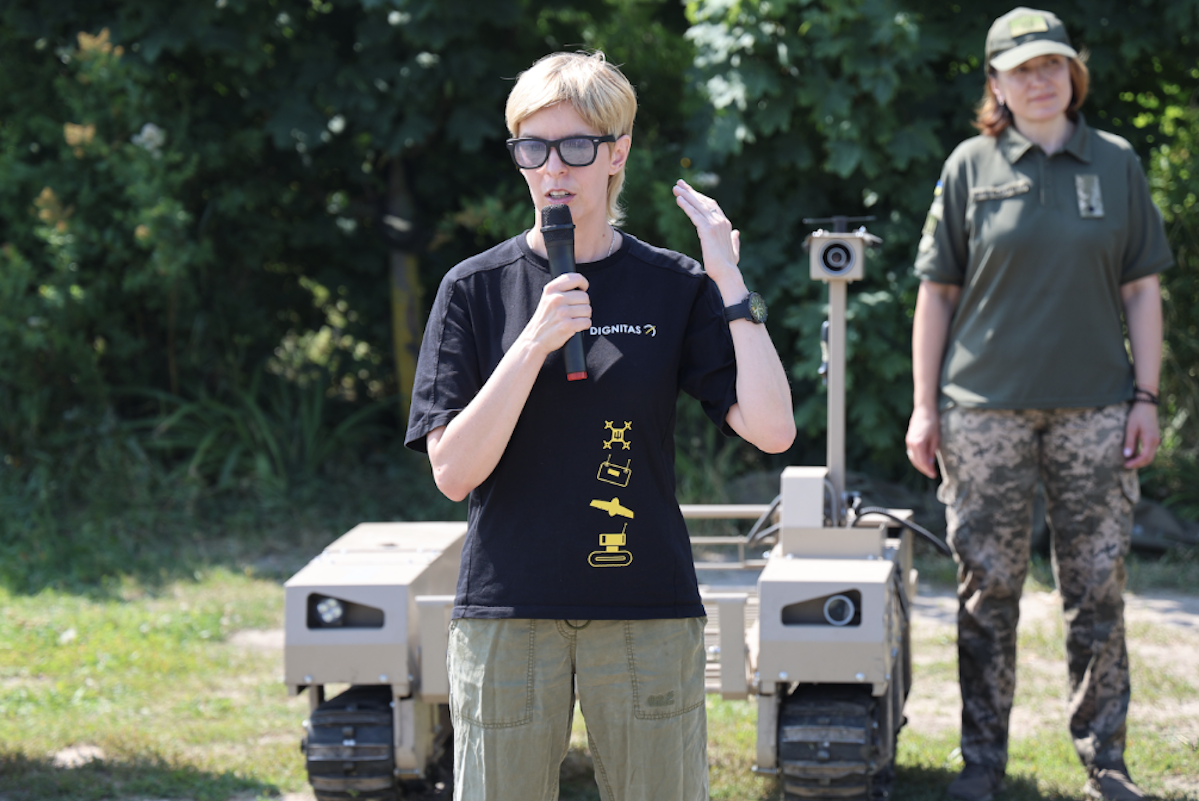
“We’re different from traditional charities as we don’t just fundraise and donate gear,” she added. We build and test solutions, prove their value, and then advocate for government adoption.”Dignitas’ Lyuba Shipovich and Stepan Nehoda with a ground robot deployed to the front in the Ukraine war. Photo: David KirichenkoLast month, this writer traveled with Shipovich and Dignitas executive Stepan Nehoda as they visited brigades working on robotics across various fronts.
At each base we visited, every commander was eager to speak with her.“The people we work with [generally] love us. [But] some officers hate us because we push them to do more work,” she said. I was told by officers that Shipovich has the clout to influence the General Staff of the Ukrainian Army, and that she plays a role in shaping planning and resource allocation at the highest levels.
Each robotics unit was quick to show off its homemade battlefield tools and other war-fighting innovations built in garages and workshops. I joined Shipovich on some of these visits and saw firsthand the kind of ingenuity that is helping Ukraine stay in the fight.To be sure, some brigades are better resourced than others.
But even those with very limited support are doing impressive work, cobbling together battlefield solutions to stay operational. Operators from the 3rd Assault Brigade told me that ground robots are now being used for medical evacuations nearly every day. Other units are relying on robots to handle logistics such as delivering supplies, thereby reducing the risks to human soldiers.
Oleksandr, the platoon commander of Ground Robotic Complexes (GRC) with the Antares Battalion of the Rubizh Brigade, described how volunteers are helping Ukraine adapt on the battlefield. “Volunteers like Dignitas serve as a bridge between tech developers and the military,” he said. “They help rapidly test new solutions, adapt them to real battlefield conditions and quickly deliver what actually works on the front lines.
”“This isn’t just humanitarian support,” he added. “It’s the real-time development of combat capabilities.” Oleksandr, known as Ghost, has seen firsthand how ground robotic platforms are reshaping the war. “Ground robotic platforms are already proving their effectiveness in logistics, evacuation and fire support,” he said.
“Over the next year, their role will only grow. They reduce risks for personnel, automate routine or dangerous tasks, and enhance the overall tactical flexibility of units.”Ruslan serves in an unmanned ground vehicle (UGV) unit with the Bulava Battalion of Ukraine’s 72nd Mechanized Brigade. Photo: David KirichenkoRuslan, callsign “Light,” a unmanned ground vehicle (UGV) operator with the Bulava Battalion of Ukraine’s 72nd Mechanized Brigade, said his unit has avoided driver fatalities by using UGVs, though some have been wounded.
Before adopting robots, they lost four vehicles in May alone, with several more damaged. Losses have increased as Russian forces now target logistics deeper in the rear, focusing on first-person view (FPV) drone operators as higher-value targets than infantry. Russian forces often use fiber-optic FPV drones to ambush supply routes, hiding until vehicles appear.
“This is no longer science fiction,” said Oleksandr. “It’s a tool of war.”One recent operation showed just how far the technology has come. In the Kharkiv region, soldiers from the 3rd Assault Brigade carried out a successful mission without a single infantryman on the ground. Using only FPV drones and ground robots, they attacked enemy positions, destroyed fortifications and captured Russian soldiers who surrendered to the machines.
The remaining Russian troops were directed toward Ukrainian positions by drones overhead and were then taken prisoner. “This is the first confirmed successful assault in modern warfare conducted exclusively by unmanned platforms,” the 3rd Assault Brigade claimed.At a recent demonstration of robotic systems near Kyiv, Volodymyr Rovensky, an officer in the Department for the Development of Ground Control Systems for Unmanned Systems under the Land Forces Command of the Armed Forces of Ukraine, provided a broader view.
He noted that 22 combat units are already deploying ground robots. According to Rovensky, 47% of all missions carried out by these systems involve logistics and evacuation, 25% focus on engineering tasks, 12% are used in combat operations and the rest are dedicated to special tasks. He emphasized that technological superiority will determine the next phase of the war.
“Our primary task,” Rovensky said, “is to provide the army with robotic complexes that can replace the infantry.” The ultimate goal is to see ground robots deployed at scale across the entire frontline.A ground robot from Ukraine’s 72nd Mechanized Brigade driving through a muddy road. Photo: David KirichenkoShipovich stated that “the idea that robots can fully replace infantry is both true and false.
Today, they cannot, but that should be our goal.” She added, “We must get people out of the trenches and off the front line. Robots can do the dirty, dangerous work.”“Today, 99% of ground drones in military use are Ukrainian-made,” she said. “Other countries are studying our approach because what worked in US labs or fields is not viable in war.
Ukrainian engineers are creating the future of warfare, not just for Ukraine, but for the world.”Shipovich isn’t just focused on robots. She spends much of her time thinking about artificial intelligence and how to apply it more widely across drones on the battlefield and to integrate into ground robots to make them even more effective.
Shipovich envisions a wider technological shield that will protect Ukraine in the future, where drones and ground robots hold the frontline. “Technology is everything,” she said.David Kirichenko is associate research fellow at the London-based Henry Jackson Society think tank and a Ukrainian-American freelance journalist, activist and security engineer who reports from the Ukraine side of the war.
Follow him on X at @DVKirichenko
Source coverage
Publisher: Asia Times
Author: David Kirichenko
Deeper analysis
Full source content
When Russia launched its full-scale invasion of Ukraine in February 2022, Ukrainians across the globe mobilized to defend their homeland. Some picked up weapons while others contributed with their technical abilities. Now in a fourth year of fighting, Ukraine’s wartime resilience endures, thanks in large part to volunteers and tech pioneers who have raced to out-innovate Russia on the battlefield.
Among them is Lyuba Shipovich, a software engineer and tech entrepreneur who had been running a tech company in New York City. She left the United States and returned to Ukraine at the beginning of Russia’s full-scale invasion to join the resistance. By 2023, she founded Dignitas, a nonprofit dedicated to training Ukrainian soldiers and integrating cutting-edge technologies into Ukraine’s military operations.
Dignitas has already spearheaded major initiatives like Victory Drones, a drone-training outfit for the military, civilians and producers, and helped drone operators scale across Ukraine’s army. Now, Shipovich is turning her focus to ground robotics, working to ensure Ukraine’s military can rapidly adopt and deploy unmanned ground systems (UGVs) across the frontlines.
The company’s latest initiative is Victory Robots. In a social media post from June, the project team wrote that Dignitas Ukraine is ”building a tech-driven advantage for Ukraine’s defenders” and that “it’s all about giving Ukraine every possible advantage to win – while protecting lives and reducing human losses.
”After years of grinding warfare, Ukraine is facing a severe manpower shortage. Russia, with a population more than three times larger and fueled by oil and gas revenues, can offer higher pay to attract new recruits, giving it a significant advantage in replenishing its ranks.In turn, that means Russia can send wave after wave of soldiers to die on Ukrainian soil.
Ukraine cannot match Russia’s numbers and has thus turned to technology to sustain its war effort. But bringing this technology to the front is not easy. Resistance is often retrenched, particularly among Soviet-trained officers who often struggle to understand or trust these new tech capabilities.
This is where Shipovich plays an important role. Every month, she travels to brigades across the war front, listening to commanders, identifying their pain points and seeking ways to support the deployment of new technologies, including ground robots.“We train the military on tech, provide them with tech and push for systemic adoption of battlefield innovation,” said Shipovich in an interview.
“We’re different from traditional charities as we don’t just fundraise and donate gear,” she added. We build and test solutions, prove their value, and then advocate for government adoption.”Dignitas’ Lyuba Shipovich and Stepan Nehoda with a ground robot deployed to the front in the Ukraine war. Photo: David KirichenkoLast month, this writer traveled with Shipovich and Dignitas executive Stepan Nehoda as they visited brigades working on robotics across various fronts.
At each base we visited, every commander was eager to speak with her.“The people we work with [generally] love us. [But] some officers hate us because we push them to do more work,” she said. I was told by officers that Shipovich has the clout to influence the General Staff of the Ukrainian Army, and that she plays a role in shaping planning and resource allocation at the highest levels.
Each robotics unit was quick to show off its homemade battlefield tools and other war-fighting innovations built in garages and workshops. I joined Shipovich on some of these visits and saw firsthand the kind of ingenuity that is helping Ukraine stay in the fight.To be sure, some brigades are better resourced than others.
But even those with very limited support are doing impressive work, cobbling together battlefield solutions to stay operational. Operators from the 3rd Assault Brigade told me that ground robots are now being used for medical evacuations nearly every day. Other units are relying on robots to handle logistics such as delivering supplies, thereby reducing the risks to human soldiers.
Oleksandr, the platoon commander of Ground Robotic Complexes (GRC) with the Antares Battalion of the Rubizh Brigade, described how volunteers are helping Ukraine adapt on the battlefield. “Volunteers like Dignitas serve as a bridge between tech developers and the military,” he said. “They help rapidly test new solutions, adapt them to real battlefield conditions and quickly deliver what actually works on the front lines.
”“This isn’t just humanitarian support,” he added. “It’s the real-time development of combat capabilities.” Oleksandr, known as Ghost, has seen firsthand how ground robotic platforms are reshaping the war. “Ground robotic platforms are already proving their effectiveness in logistics, evacuation and fire support,” he said.
“Over the next year, their role will only grow. They reduce risks for personnel, automate routine or dangerous tasks, and enhance the overall tactical flexibility of units.”Ruslan serves in an unmanned ground vehicle (UGV) unit with the Bulava Battalion of Ukraine’s 72nd Mechanized Brigade. Photo: David KirichenkoRuslan, callsign “Light,” a unmanned ground vehicle (UGV) operator with the Bulava Battalion of Ukraine’s 72nd Mechanized Brigade, said his unit has avoided driver fatalities by using UGVs, though some have been wounded.
Before adopting robots, they lost four vehicles in May alone, with several more damaged. Losses have increased as Russian forces now target logistics deeper in the rear, focusing on first-person view (FPV) drone operators as higher-value targets than infantry. Russian forces often use fiber-optic FPV drones to ambush supply routes, hiding until vehicles appear.
“This is no longer science fiction,” said Oleksandr. “It’s a tool of war.”One recent operation showed just how far the technology has come. In the Kharkiv region, soldiers from the 3rd Assault Brigade carried out a successful mission without a single infantryman on the ground. Using only FPV drones and ground robots, they attacked enemy positions, destroyed fortifications and captured Russian soldiers who surrendered to the machines.
The remaining Russian troops were directed toward Ukrainian positions by drones overhead and were then taken prisoner. “This is the first confirmed successful assault in modern warfare conducted exclusively by unmanned platforms,” the 3rd Assault Brigade claimed.At a recent demonstration of robotic systems near Kyiv, Volodymyr Rovensky, an officer in the Department for the Development of Ground Control Systems for Unmanned Systems under the Land Forces Command of the Armed Forces of Ukraine, provided a broader view.
He noted that 22 combat units are already deploying ground robots. According to Rovensky, 47% of all missions carried out by these systems involve logistics and evacuation, 25% focus on engineering tasks, 12% are used in combat operations and the rest are dedicated to special tasks. He emphasized that technological superiority will determine the next phase of the war.
“Our primary task,” Rovensky said, “is to provide the army with robotic complexes that can replace the infantry.” The ultimate goal is to see ground robots deployed at scale across the entire frontline.A ground robot from Ukraine’s 72nd Mechanized Brigade driving through a muddy road. Photo: David KirichenkoShipovich stated that “the idea that robots can fully replace infantry is both true and false.
Today, they cannot, but that should be our goal.” She added, “We must get people out of the trenches and off the front line. Robots can do the dirty, dangerous work.”“Today, 99% of ground drones in military use are Ukrainian-made,” she said. “Other countries are studying our approach because what worked in US labs or fields is not viable in war.
Ukrainian engineers are creating the future of warfare, not just for Ukraine, but for the world.”Shipovich isn’t just focused on robots. She spends much of her time thinking about artificial intelligence and how to apply it more widely across drones on the battlefield and to integrate into ground robots to make them even more effective.
Shipovich envisions a wider technological shield that will protect Ukraine in the future, where drones and ground robots hold the frontline. “Technology is everything,” she said.David Kirichenko is associate research fellow at the London-based Henry Jackson Society think tank and a Ukrainian-American freelance journalist, activist and security engineer who reports from the Ukraine side of the war.
Follow him on X at @DVKirichenko
How this page is built
Goose Pod turns cited reporting into a public episode summary first, then pairs that summary with audio playback so listeners can check the source material before they decide how deeply to engage.
The goal is to make this page useful as a news landing page first, while still giving listeners transcript access, related episodes, and direct links back to the original publishers.