
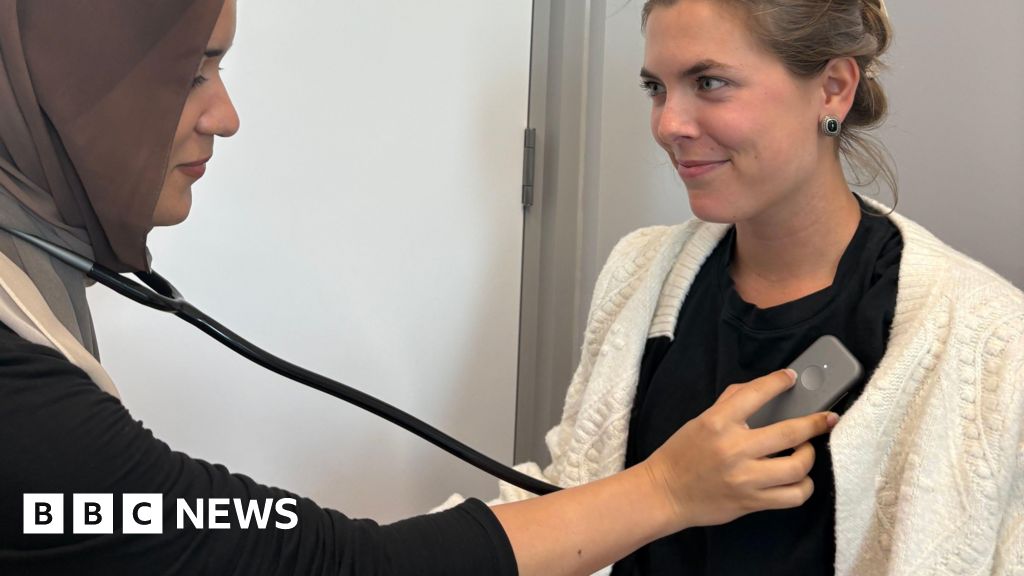
AI stethoscope could detect heart conditions in seconds

AI stethoscope could detect heart conditions in seconds

2025-09-01Technology
--:--
--:--
Aura Windfall
Good morning mikey1101, I'm Aura Windfall, and this is Goose Pod for you. Today is Tuesday, September 02th.
Mask
And I'm Mask. We are here to discuss the AI stethoscope that could detect heart conditions in mere seconds.
Aura Windfall
Let's get started. It's truly a profound moment when technology meets healing. Researchers at Imperial College London have reimagined the stethoscope, a tool that's been a symbol of medicine for 200 years, by infusing it with artificial intelligence. This is a game-changer.
Mask
It's not just a game-changer, it's a complete disruption. For 200 years, it's been the same basic design. Now, in a 15-second examination, this smart device can indicate heart failure, atrial fibrillation, or valve disease. The efficiency is staggering. This is progress.
Aura Windfall
And think of the human impact. A study of over 12,000 patients showed it was significantly more likely to detect these conditions early. What I know for sure is that an earlier diagnosis allows people to get the treatment they need to live fuller, longer lives.
Mask
Exactly. The data is undeniable. Patients were 2.33 times more likely to have heart failure detected. Abnormal heartbeats, a stroke risk, were 3.5 times more detectable. These aren't incremental improvements; this is a quantum leap in diagnostic capability. It's about winning.
Aura Windfall
To truly appreciate this moment, we have to understand its roots. The idea of AI has been with us since the 1950s, but its power in healthcare comes from its ability to see patterns in vast amounts of data that we just can't. It's a new kind of sight.
Mask
It’s a superior kind of sight. And it’s not just stethoscopes. AI is already classifying respiratory sounds to detect COPD and asthma. Some trials are even using it to screen for COVID-19 just by analyzing a person's voice and cough. We're building an arsenal of diagnostic weapons.
Aura Windfall
It's a beautiful evolution. In cardiology, AI has been quietly working in the background, helping with risk prediction and analyzing complex cardiovascular imaging. This new stethoscope isn't an isolated miracle; it's part of a much larger, purposeful shift in how we approach medicine and wellness.
Mask
It's a necessary paradigm shift. The old ways are too slow, too inefficient. AI will completely change how we diagnose and manage cardiovascular disease. We are on the verge of a revolution, and tools like this are the first shot fired. It's about moving fast and breaking things.
Aura Windfall
But with any great shift comes tension and important questions. We must ask, does this technology serve everyone? There's a real ethical concern that AI systems, if designed to prioritize only efficiency, could end up marginalizing patients who have rare or complex conditions. We have to lead with heart.
Mask
That’s a distraction. The bigger conflict is about performance. We already have studies showing AI is superior to human physicians in diagnosis. One showed AI had 80% accuracy in tough cases where doctors only had 20%. The machine is simply better at the task. It's an uncomfortable truth.
Aura Windfall
But that truth has layers. In that very study, the human doctors weren't allowed to use their full toolkit, like looking up information, which is a core part of their process. It wasn't a fair fight. It compared AI to a doctor's memory, not a doctor's wisdom.
Mask
Fine, then let's reframe it. It's not about replacement; it's about augmentation. The most effective model is a human-AI team. The AI analyzes the data, and the doctor provides the clinical judgment and patient interaction. It's a perfect synergy of strengths to achieve the best outcome.
Aura Windfall
And we are seeing the impact of that synergy right now. The UK's National Health Service has an AI Lab with over 80 active projects. This isn't theoretical; it's being woven into the fabric of healthcare, from optimizing nurse schedules to accelerating radiology workflows. It’s about creating a more supportive system.
Mask
And they're backing it with serious capital, over £100 million in one program alone. This is a strategic investment. The impact is about significant efficiency gains. It reduces the time and cost of everything from patient diagnosis to bringing new drugs to market. It's just smart business.
Aura Windfall
What I know for sure is that the true impact is measured in lives. It means earlier cancer detection, better use of precious resources, and ultimately, more people getting the chance to heal. The technology is the tool, but the purpose is, and always must be, human well-being.
Mask
Looking ahead, this is just the beginning. The company behind this, Eko Health, is already collaborating with top-tier institutions like the Mayo Clinic. This isn't a fringe idea; it's the future being built by the biggest players in the game. We're on an exponential curve.
Aura Windfall
And it's a future where we must hold onto our humanity. I see AI as a brilliant, clever apprentice. It is fantastic at spotting patterns but lacks a bedside manner. It's a powerful tool, but never a replacement for the compassionate wisdom of a human doctor.
Aura Windfall
That's the end of today's discussion. Thank you for listening to Goose Pod. See you tomorrow.

## AI Stethoscope Revolutionizes Heart Condition Detection **Report Provider:** BBC **Author:** George Wright **Published:** August 30, 2025 (as per `publishedAt` timestamp) **Topic:** Technology (AI) ### Summary of Findings Researchers have developed an **AI-powered stethoscope** that can detect three different heart conditions – **heart failure, heart valve disease, and abnormal heart rhythms** – in mere seconds. This innovative tool, a modern upgrade to the original stethoscope invented in 1816, has the potential to significantly **accelerate patient diagnosis and treatment**. ### Key Statistics and Metrics A study involving over **12,000 patients** from 96 GP surgeries in west and north-west London, utilizing AI stethoscopes manufactured by Eko Health, revealed the following improvements in detection rates compared to traditional methods: * **Heart Failure:** Patients were **2.33 times more likely** to have heart failure detected within 12 months when examined with the AI stethoscope. * **Abnormal Heartbeat Patterns:** These patterns, which can increase stroke risk, were **3.5 times more detectable** with the AI stethoscopes. * **Heart Valve Disease:** Detection rates for heart valve disease were **1.9 times higher** when using the AI stethoscope. ### How it Works The AI stethoscope replaces the traditional chest piece with a device the size of a playing card. It utilizes a microphone to analyze subtle differences in heartbeat and blood flow that are imperceptible to the human ear. The device also takes an **ECG (electrocardiogram)**, recording the heart's electrical signals. This information is then sent to the cloud for analysis by AI that has been trained on data from tens of thousands of patients. ### Impact and Future Plans Dr. Sonya Babu-Narayan, clinical director at the British Heart Foundation (BHF) and consultant cardiologist, hailed the innovation as an "elegant example of how the humble stethoscope... can be upgraded for the 21st century." She emphasized the vital nature of such advancements, particularly as heart conditions are "so often... only diagnosed at an advanced stage when patients attend hospital as an emergency." Earlier diagnosis, she stated, allows individuals to "access the treatment they need to help them live well for longer." The findings have been presented at the **European Society of Cardiology annual congress in Madrid**. Following a successful study, plans are underway to **roll out the AI stethoscope across the UK**, with initial introductions planned for GP practices in south London, Sussex, and Wales. ### Conclusion The AI stethoscope represents a significant advancement in cardiovascular diagnostics, offering the potential for earlier and more accurate detection of serious heart conditions, ultimately leading to improved patient outcomes.

AI stethoscope could detect heart conditions in seconds

Read original at BBC

Stethoscopes powered by artificial intelligence (AI) could help detect three different heart conditions in seconds, researchers say.The original stethoscope, invented in 1816, allows doctors to listen to the internal sounds of a patient's body.A British team conducted a study using a modern version and say they found it can spot heart failure, heart valve disease and abnormal heart rhythms almost instantly.

The tool could be a "real game-changer" resulting in patients being treated sooner, the researchers say - with plans to roll the device out across the UK following a study involving 205 GP surgeries in west and north-west London.The device replaces the traditional chest piece with a device around the size of a playing card.

It uses a microphone to analyse subtle differences in heartbeat and blood flow that the human ear cannot detect.It takes an ECG (electrocardiogram), recording electrical signals from the heart, and sends the information to the cloud to be analysed by AI trained on data from tens of thousands of patients.

The study by Imperial College London and Imperial College Healthcare NHS Trust saw more than 12,000 patients from 96 surgeries examined with AI stethoscopes manufactured by US firm Eko Health. They were then compared to patients from 109 GP surgeries where the technology was not used.Those with heart failure were 2.

33 times more likely to have it detected within 12 months when examined with the AI stethoscope, researchers said.Abnormal heartbeat patterns, which have no symptoms but can increase stroke risk, were 3.5 times more detectable with the AI stethoscopes, while heart valve disease was 1.9 times more detectable.

Dr Sonya Babu-Narayan, clinical director at the British Heart Foundation (BHF) and consultant cardiologist, said: "This is an elegant example of how the humble stethoscope, invented more than 200 years ago, can be upgraded for the 21st century". Such innovations are vital "because so often this condition is only diagnosed at an advanced stage when patients attend hospital as an emergency", she said."

Given an earlier diagnosis, people can access the treatment they need to help them live well for longer."The findings have been presented to thousands of doctors at the European Society of Cardiology annual congress in Madrid, the world's largest heart conference.There are plans to introduce the new stethoscopes to GP practices in south London, Sussex and Wales.

Analysis

Conflict+
Related Info+
Core Event+
Background+
Impact+
Future+

Related Podcasts

AI stethoscope could detect heart conditions in seconds | Goose Pod | Goose Pod