
What happened
This report from Ars Technica, authored by Ryan Whitwam, details Google's new experimental feature called "Web Guide," which aims to organize search results using Artificial Intelligence. The experiment is currently available as an opt-in feature through Search Labs, with the article published on July 24, 2025.
Key Findings and Features:
Context and Implications:
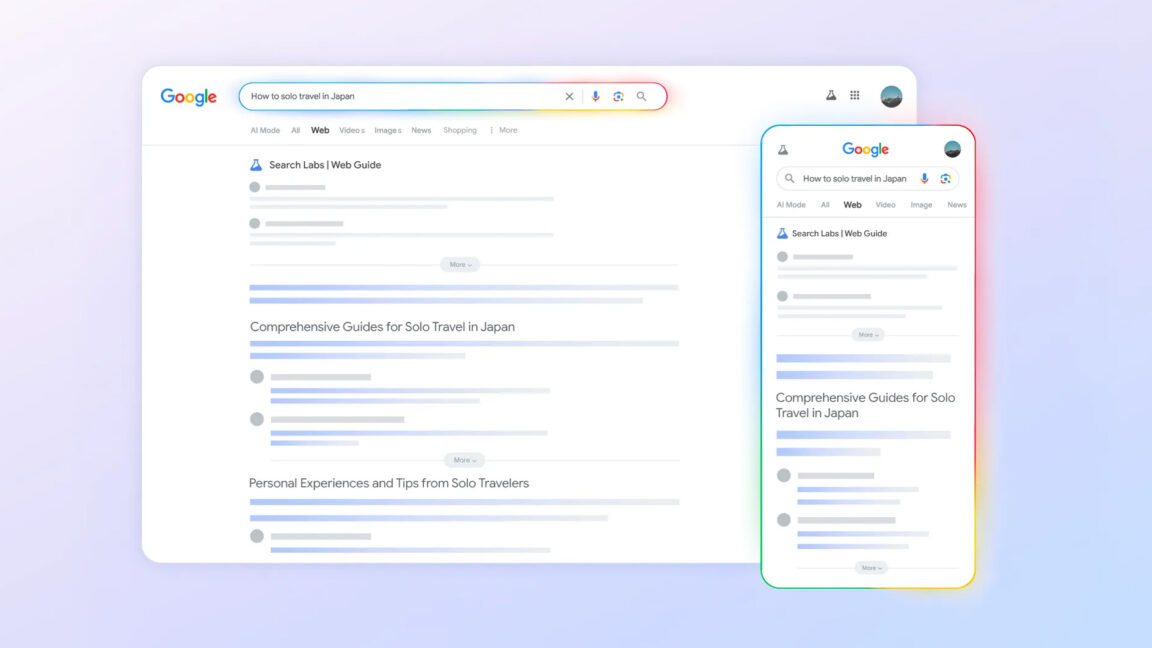
Web Guide is halfway between normal search and AI Mode.Credit:GoogleWeb Guide is halfway between normal search and AI Mode.Credit:GoogleGoogle suggests trying Web Guide with longer or open-ended queries, like "how to solo travel in Japan." The video below uses that search as an example. It has many of the links you might expect, but there are also AI-generated headings with summaries and suggestions.
It really looks halfway between standard search and AI Mode. Because it has to run additional searches and generate content, Web Guide takes a beat longer to produce results compared to a standard search. There's no AI Overview at the top, though.Web Guide is a Search Labs experiment, meaning you have to opt-in before you'll see any AI organization in your search results.
When enabled, this feature takes over the "Web" tab of Google search. Even if you turn it on, Google notes there will be a toggle that allows you to revert to the normal, non-AI-optimized page.An example of the Web Guide test.An example of the Web Guide test.Eventually, the test will expand to encompass more parts of the search experience, like the "All" tab—that's the default search experience when you input a query from a browser or phone search bar.
Google says it's approaching this as an opt-in feature to start. So that sounds like Web Guide might be another AI Mode situation in which the feature rolls out widely after a short testing period. It's technically possible the test will not result in a new universal search feature, but Google hasn't yet met a generative AI implementation that it hasn't liked.
Source coverage
This report from Ars Technica, authored by Ryan Whitwam, details Google's new experimental feature called "Web Guide," which aims to organize search results using Artificial Intelligence. The experiment is currently available as an opt-in feature through Search Labs, with the article published on July 24, 2025.
Key Findings and Features:
Deeper analysis
Full source content
Web Guide is halfway between normal search and AI Mode.Credit:GoogleWeb Guide is halfway between normal search and AI Mode.Credit:GoogleGoogle suggests trying Web Guide with longer or open-ended queries, like "how to solo travel in Japan." The video below uses that search as an example. It has many of the links you might expect, but there are also AI-generated headings with summaries and suggestions.
It really looks halfway between standard search and AI Mode. Because it has to run additional searches and generate content, Web Guide takes a beat longer to produce results compared to a standard search. There's no AI Overview at the top, though.Web Guide is a Search Labs experiment, meaning you have to opt-in before you'll see any AI organization in your search results.
When enabled, this feature takes over the "Web" tab of Google search. Even if you turn it on, Google notes there will be a toggle that allows you to revert to the normal, non-AI-optimized page.An example of the Web Guide test.An example of the Web Guide test.Eventually, the test will expand to encompass more parts of the search experience, like the "All" tab—that's the default search experience when you input a query from a browser or phone search bar.
Google says it's approaching this as an opt-in feature to start. So that sounds like Web Guide might be another AI Mode situation in which the feature rolls out widely after a short testing period. It's technically possible the test will not result in a new universal search feature, but Google hasn't yet met a generative AI implementation that it hasn't liked.
How this page is built
Goose Pod turns cited reporting into a public episode summary first, then pairs that summary with audio playback so listeners can check the source material before they decide how deeply to engage.
The goal is to make this page useful as a news landing page first, while still giving listeners transcript access, related episodes, and direct links back to the original publishers.