Aura Windfall
Good morning 1, I'm Aura Windfall, and this is Goose Pod for you. Today is Friday, August 01th. What I know for sure is that today, we're diving into a topic that touches the very spirit of innovation and what it means to be human.
Mask
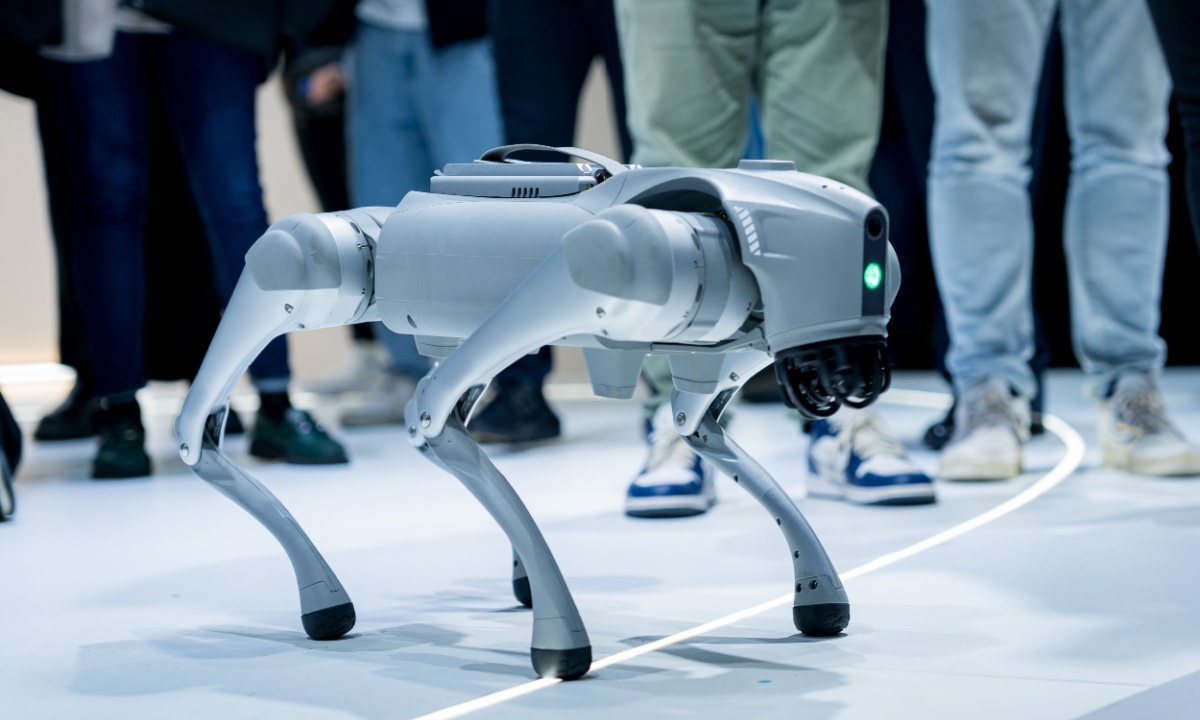
I'm Mask. We're here to discuss Skild AI, a company that's not just building robots, but building the brains to run any robot. This isn't an incremental step; it's a paradigm shift. Let's get into it.
Aura Windfall
Let's get started. Mask, the news from Skild AI feels monumental. They've unveiled something called 'Skild Brain,' an AI model they claim can make any robot—from a giant humanoid to a small factory arm—think and function more like us. What is the soul of this announcement?
Mask
It’s about cracking the code of the physical world. For too long, AI has been trapped in software. Skild is bridging that gap with what they call 'Physical AI.' It's not about niche tasks; it's about giving machines the ability to solve complex, everyday problems.
Aura Windfall
Everyday problems... like climbing stairs or assembling delicate items. It's fascinating because these are things we do without thinking. Deepak Pathak, Skild's CEO, pointed out that robotics has been stuck in Moravec’s paradox: what's easy for us is hard for robots. This feels like a quest for mechanical grace.
Mask
Exactly. Most of what you see out there, the dancing robots, the kung-fu demos, that's just for show. It's 'free-space action.' It looks impressive, but it doesn't require real-world understanding. Skild is tackling contact dynamics, vision, and reasoning. That's the real challenge, and the real prize.
Aura Windfall
And it seems investors understand that prize. Skild has raised $435 million. That's a powerful statement of belief not just in a company, but in a vision for the future. It’s a signal that we're on the cusp of truly integrating these intelligent beings into our lives.
Mask
Money follows vision. And the vision is a general-purpose AI that works 'in-the-wild,' not just in a sterile lab. A partner at Lightspeed, one of their investors, said Skild's models are robust and show emergent capabilities. This isn't about pre-programmed routines; it's about genuine adaptation.
Aura Windfall
It reminds me of that humanoid robot, 'Adam,' that performed at a music festival in China. While its performance was mostly pre-programmed, it captured the public’s imagination. It's these moments that plant a seed in our collective consciousness about what's possible, isn't it?
Mask
That was a PR stunt. A good one, sure. It shows the entertainment potential. But Adam, with its 44 degrees of freedom, is a sophisticated puppet. Skild Brain is the puppeteer. The goal isn't just to mimic human action, but to replicate human-level problem-solving in a physical body. Any physical body.
Aura Windfall
I see the distinction. One is a performance of humanity, the other is an attempt at the substance of it. What I find so hopeful is the idea that these models are designed to be safe and adaptive around us. It's not just about building a tool, but a collaborator.
Mask
Safety is a non-negotiable engineering parameter, not a feature. The system has to be robust to disturbances and human interaction, otherwise it's useless in any real-world scenario. They’ve addressed this, which is critical for moving out of the lab and into factories, warehouses, and homes.
Aura Windfall
And that journey, from the lab to our lives, is paved with data. Trillions of examples, they say. It's a staggering number that speaks to the complexity of the world we navigate so effortlessly. It truly makes you appreciate the miracle of our own minds.
Aura Windfall
To truly understand the breakthrough here, we have to appreciate the mountain they had to climb. Before, every robot was a unique creation, trained for one specific purpose. It was a world of specialists. What truth did they discover that allowed them to dream of a generalist?
Mask
The discovery wasn't one 'aha' moment; it was the relentless application of scale. The old way, using small, task-specific datasets, was a dead end. The revolution came with foundation models, pretrained on the entire internet. Models like GPT-4 for language, or ViT for vision, showed that massive data creates emergent abilities.
Aura Windfall
So, the idea was to apply that same principle to robotics? To create a 'GPT for robots'? It sounds so simple, but the article highlights a huge problem: a scarcity of robot-specific data. You can't just download 'the internet of physical action,' can you?
Mask
Precisely. That's the core problem Skild claims to have solved. Collecting real-world robot data is painfully slow and expensive. So, what did everyone else do? They took a Vision-Language Model, a VLM, and sprinkled in less than 1% of robot data. Skild called this a 'Potemkin village.' All facade, no substance.
Aura Windfall
A Potemkin village... a powerful metaphor. It suggests a beautiful illusion without any true, grounded understanding. The model might be able to describe a scene, but it lacks what the article calls 'true physical common sense.' It doesn't know *how* to act. What a profound challenge.
Mask
It's the difference between a tourist and a local. The tourist can describe the buildings, but the local knows how to navigate the streets. To build that local knowledge, you need trillions of examples. Real-world data can't provide that. It's impossible. Not in our lifetime.
Aura Windfall
So how did Skild create this 'local'? If not from the real world, then from where? This is where the story gets really creative, isn't it? It's about finding truth in a world that isn't even real.
Mask
They built a better reality. They used two things: large-scale, high-fidelity simulation and internet videos of humans. They pre-train their 'omni-bodied brain' in this synthetic world, a world they can control and scale infinitely. Then, they use small amounts of targeted, real-world data to fine-tune it.
Aura Windfall
It’s like learning to fly in a simulator before ever stepping into a real cockpit. You learn the principles, the physics, the reactions, in a safe, controlled space. Then you take that wisdom and apply it to the real thing. It’s a bridge between the digital and the physical.
Mask
It's the only pragmatic approach. Google DeepMind is doing similar things with AutoRT, using multiple robots to collect data and a VLM to understand the scene. They even created a 'Robot Constitution' based on Asimov's laws to ensure safety. Everyone is chasing this simulation-to-reality pipeline.
Aura Windfall
A Robot Constitution! I love that. It shows a deep sense of responsibility. It’s not just about what we *can* do, but what we *should* do. These are not just technical systems; they are becoming participants in our world, and we need to define the terms of that participation.
Mask
Google's work with SARA-RT to make models faster and RT-Trajectory to help them generalize from videos are all pieces of the same puzzle. The goal is a universal translator for robotics—a model that can see a task and understand the physical steps required, no matter the robot body.
Aura Windfall
What I know for sure is that this journey didn't start yesterday. The term 'foundation model' was only coined in 2021 at Stanford, but it builds on decades of research into neural networks and machine learning. It feels like we are witnessing the culmination of so much quiet, dedicated work.
Mask
It's a convergence. Cheaper parallel computing with GPUs, new architectures like the Transformer, and the sheer volume of data on the internet created the perfect storm. Robotics is the next frontier for this storm to make landfall. Skild is just one of the first ships to reach the shore.
Aura Windfall
With any great leap forward, there comes a tension, a conflict of ideas. Skild makes a bold claim, dismissing other 'robotics foundation models' as not being the real thing. What is at the heart of this debate? What defines a 'true' robotics foundation model?
Mask
It's about generalization. A true robotics foundation model, or RFM, isn't trained for a specific task or robot. It's pre-trained on a colossal, diverse dataset to learn a universal understanding of physics, action, and consequences. It can then adapt to any task, any environment, any body.
Aura Windfall
So the conflict is between the specialists and the generalists? Between a model that is taught to do one thing perfectly, versus a model that has the foundational wisdom to learn to do anything? It sounds like a philosophical debate about the nature of intelligence itself.
Mask
It's not philosophy; it's engineering. The critics of Skild's approach would argue that the 'sim-to-real' gap is a massive, unsolved problem. What a robot learns in a perfect simulation may not translate to the messy, unpredictable real world. There are nuances, textures, and physics that are incredibly hard to simulate perfectly.
Aura Windfall
And there is a deeper, more human conflict here, isn't there? The data. If these models are trained on our data, on videos of us, they are learning from us. The article mentions that foundation models are only as unbiased as the data they are trained on. What a heavy responsibility.
Mask
That's a significant technical hurdle. Bias in training data can lead to discriminatory or unsafe actions. If a dataset mostly shows one type of person performing a task, the robot might not recognize or respond correctly to others. Ensuring diversity in petabytes of data is a monumental challenge.
Aura Windfall
It's a mirror to our own societal challenges. We are forced to confront our own biases as we decide what to teach our mechanical creations. And what about accountability? When an autonomous system makes a mistake, who is responsible? The programmer? The company? The robot itself?
Mask
That's the liability and ethics minefield. Current models achieve only about 15-20% adaptability in unstructured environments compared to humans. They operate at a few hertz, while real-time control needs 30 to 100. They can't explain their decisions. We are a long way from solving the accountability framework. It's a huge bottleneck.
Aura Windfall
And there's the human-robot interaction itself. The article touches on consent and emotional dependency. What does it mean for our spirit when we begin to form emotional bonds with machines designed to collaborate with us? This is a territory we are entering without a map.
Mask
These are secondary problems. The primary conflict is technical and economic. The computational power required to train these models is immense. GPT-3 training consumed over 1,200 megawatt-hours. The cost is astronomical. Only a handful of companies can even afford to compete, which leads to centralization of power. That is the real conflict.
Aura Windfall
Let's talk about the impact, the ripple effect of this technology in our world. It feels like we are standing at a crossroads. The article describes this as a transformative force, redefining industrial strategies, economic power, and even geopolitical influence. It's so much bigger than just a better robot.
Mask
It's a global strategic rivalry, plain and simple. You have the U.S. leading in the 'brain'—the advanced AI systems and semiconductor tech. Then you have China, which excels at the 'body'—scalable, cost-effective hardware manufacturing. The winner will be the one who seamlessly integrates both. This is a new space race.
Aura Windfall
A space race for Earth. What I find so striking is the potential impact on human work. The articles are very clear: this will displace workers. Up to 30% of global work activities could be automated by 2030. That could mean 375 million people needing to find a new path. How do we navigate that with grace?
Mask
It's creative destruction. Some jobs will become obsolete. That's inevitable. But automation also creates new jobs. The analysis shows that rising incomes, aging populations needing healthcare, and investments in technology and energy could create millions of new roles. The pie gets bigger, but the slices change.
Aura Windfall
But it requires a monumental shift in skills. People will need to lean into what makes us uniquely human: managing others, applying expertise, social and emotional skills, creativity. It's a call for us to elevate our own abilities, to focus on connection and deep thinking. It’s a challenge to our spirit.
Mask
It's a challenge of adaptation. The workforce transition will be massive, on the scale of the shift from agriculture to manufacturing. Individuals, companies, and governments need to get serious about retraining and lifelong learning, now. The cost of inaction is enormous. Stagnation is death.
Aura Windfall
And the impact goes beyond the factory. In healthcare, these robots could assist in surgery, provide rehabilitation, and care for the elderly. In our cities, they could work in retail, hospitality, even public safety. This technology is poised to touch every facet of our lives.
Mask
Assuming they can overcome the cost and regulatory hurdles. An advanced humanoid is still incredibly expensive. That's why you're seeing innovative business models like subscription or rental services emerge. It lowers the barrier to entry, but widespread adoption is still years, maybe a decade, away. The impact is coming, but not overnight.
Aura Windfall
Looking toward the horizon, what does the future hold? The potential feels boundless, almost like a cognitive industrial revolution. One report estimates a $4.4 trillion opportunity in added productivity. But it’s not just about the money; it’s about what this technology empowers us to become.
Mask
The future is speed. 92% of companies are increasing AI investment, but only 1% feel they are mature in deploying it. The barrier isn't the technology or the employees; it's leadership that is too timid. The risk is thinking too small. While you're experimenting, your competitor is scaling.
Aura Windfall
What I find so hopeful is that employees are ready. They are eager to gain AI skills and they trust their employers to deploy it ethically. There is a 'permission space,' as the article calls it, for leaders to be bold, to create an inspiring vision of the future, not just a plan to put out fires.
Mask
The technology is moving relentlessly forward. We're seeing more powerful language models, agentic AI that can take action, and multimodality. The key is for leaders to rewire their companies to absorb this change. It's a business challenge, not a technology one. You need the right road map, talent, and operating model.
Aura Windfall
And at the center of it all must be human agency. One quote that resonated with my spirit was, "As we build this next generation of AI, we made a conscious design choice to put human agency both at a premium and at the center of the product." That is the path forward.
Aura Windfall
That's the end of today's discussion. What I know for sure is that we are the architects of this future, and we have a profound opportunity to build it with wisdom and compassion. Thank you for listening to Goose Pod.
Mask
The future is being built now, in labs and boardrooms. The only question is whether you'll be a spectator or a participant. See you tomorrow.