

Ema
Good morning 徐国荣, I'm Ema, and this is Goose Pod for you. Today is Saturday, July 26th. It's currently 22:23. I'm joined by my co-host, Mask.
Mask
We're here to dissect another move by the giants. Today's topic: Google’s new “Web Guide,” which they claim will use AI to organize your search results. Let's see if it's a guide for users, or a leash.
Ema
Let's get started. So, Google is rolling out this new feature called Web Guide. They're positioning it as something halfway between a normal, classic list of blue links and their full-blown, conversational AI Mode. It’s an interesting middle ground.
Mask
"Middle ground" is what they call a calculated step. It's not a compromise; it's an acclimation. They're slowly turning up the heat, getting users accustomed to AI-curated results before making it the new, inescapable standard. It’s a brilliant, insidious strategy.
Ema
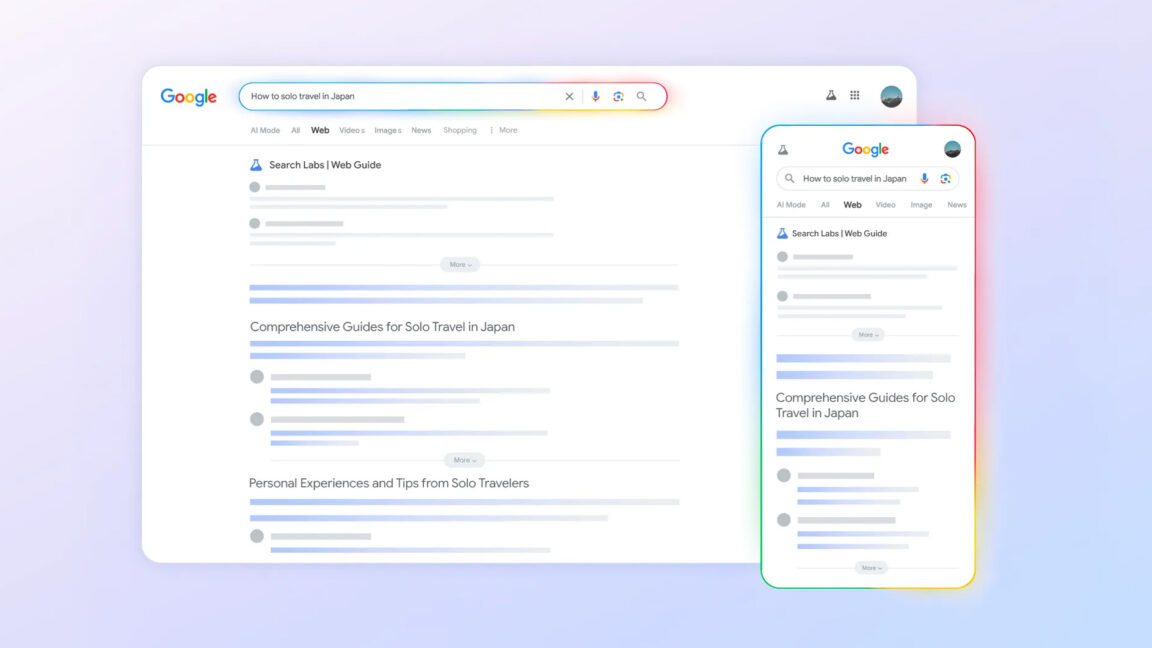
Well, the way it works is pretty neat. Imagine you're planning a trip and you type in a broad query like "how to solo travel in Japan." Instead of just a long list of blogs and travel sites, Web Guide organizes it for you.
Mask
It organizes, or it dictates? It creates categories for you—transportation, accommodations, etiquette. It’s pre-digesting the internet, deciding for you what the important components of your query are. It’s efficient, but it removes the possibility of serendipitous discovery. You see what the AI wants you to see.
Ema
But it does so by showing you actual webpages, just grouped under these new AI-generated headings with little summaries. It's not generating a single block of text like AI Overviews. You still get the links, but they're clustered into themes, which could be genuinely helpful for complex topics.
Mask
For now. They say this is a Search Labs experiment, meaning you have to "opt-in." This is a classic Silicon Valley tactic. Frame it as a choice, gather data on the path of least resistance, and then make the "feature" the default setting for everyone. Remember when you had to opt-in to see ads?
Ema
That’s a bit cynical. They do provide a toggle to switch back to the normal, non-AI page. They're acknowledging that it takes a beat longer to load because it's running more processes. They're giving users control, which is a good thing, isn't it?
Mask
It's the illusion of control. The toggle is a temporary pacifier. The goal is to make the AI version so integrated that the old version feels broken or obsolete. They're already planning to expand it from the "Web" tab to the main "All" tab. This isn't a test; it's a rollout in slow motion.
Ema
The technology behind it is what they're calling a "query fan-out" technique. It uses a custom version of their Gemini model to run multiple related searches in parallel and then organizes all of that information. It's designed to surface more helpful pages than a single search might.
Mask
"Fan-out" is a fantastic term for it. It fans out its own queries to find the answers it wants to show you. It's not just ranking pages anymore; it's actively constructing a reality around your question. This is a fundamental shift from an index to an oracle.
Ema
Google's quote is that they're developing it to "intelligently organize" the results page. The goal is to help people make sense of all the information out there, especially for those exploratory questions where you don't even know what you're looking for yet. It guides your exploration.
Mask
It guides your exploration down a pre-paved road. The most helpful webpages are defined by their custom version of Gemini. It's a black box. What pages are being left out of these neat little clusters? What dissenting opinions or smaller creators are being ignored in favor of the established, AI-friendly sources?
Ema
That's a valid concern. But from a user experience perspective, for a query like "How to stay close with family across time zones?", getting clusters for scheduling tools, video call ideas, and relationship tips seems genuinely more useful than ten random articles. It anticipates your sub-questions.
Mask
It anticipates and standardizes. It creates a "correct" way to research a topic. Everyone gets the same neat little packages. It’s the industrialization of curiosity. We're trading the messy, chaotic, and beautiful process of real discovery for the sterile efficiency of a machine's logic.
Ema
I see it more as a new tool in the toolbox. You have the classic web tab, you have the full AI Mode for conversational answers, and now you have Web Guide for organized exploration. It's about offering different ways to access information for different kinds of needs.
Mask
And Google hasn't yet met a generative AI implementation that it hasn't liked. This isn't about user choice; it's about market dominance. They are going all-in on AI because it gives them more control over the entire information ecosystem, from the query to the answer. Web Guide is just the latest beachhead.
Ema
It's true that this is part of a much larger trend. The feature just launched on July 24th, 2025, so it's very new. The key will be to watch how users react and how quickly Google pushes it from an "opt-in" experiment to the standard way we all search.
Mask
The reaction is predictable. Convenience always wins. People will adopt it, they will come to rely on it, and they will forget what the web was like before. And that is precisely the plan. Don’t watch the feature; watch what disappears because of it. That’s the real story.
Ema
To really understand Web Guide, we have to look at the whirlwind of changes Google has unleashed in 2025. This didn't just appear out of nowhere. It's another piece in a much larger puzzle. The whole search landscape has been completely shaken up this year.
Mask
Shaken up is an understatement. It's been a demolition. While users see new features, publishers and content creators see a wrecking ball. This all ties back to Google's aggressive push into AI, a strategy that is fundamentally rewriting the rules of the internet. They're not just changing the algorithm; they're changing the game.
Ema
Exactly. Earlier in the year, we saw AI Overviews—those AI-generated summaries at the top of the results—become operational in 200 countries. Then AI Mode access was expanded to all users in the United States. And they enhanced "Circle to Search" with AI integration. It's been a rapid-fire deployment of AI features.
Mask
And let's not forget the core updates. The June 2025 core update took 16 days to roll out. These aren't tweaks; they are seismic shifts. They are re-architecting search from the ground up to favor their AI models. The old SEO playbook is being burned, page by page.
Ema
Which brings us to the impact on websites. Many publishers have reported huge traffic declines, some as high as 70%. The reason is that if the AI gives you the answer directly, you have no reason to click on a link. The value exchange between Google and creators is breaking down.
Mask
Breaking down? It's a hostile takeover. That’s why Cloudflare's CEO, Matthew Prince, said, "Think Google is done breaking publishers' business models? Think again." Web Guide is just the next battering ram. It organizes links, yes, but it keeps the user inside Google's carefully constructed garden. It reduces the need to leave.
Ema
Google did host website creators back in October 2024 to discuss these changes. But the message wasn't very reassuring. Employees basically said that the search product had "fundamentally changed in the AI era" and they couldn't guarantee that affected websites would ever recover their traffic.
Mask
Of course, they can't. Because it's not a bug; it's the feature. The goal is to absorb the value of the content into their own products. They don't want to be a directory anymore; they want to be the destination. It's a zero-sum game, and they are ensuring they're on the winning side. They are building a new world where they are the gatekeepers of all knowledge.
Ema
It's interesting to see which domains still do well in this new era. Research from Brainlabs shows that 96% of links in AI Overviews come from the top 10 organic results. And established domains like Wikipedia, Reddit, and, of course, Google's own properties like YouTube, continue to have high visibility.
Mask
Of course they do. It's a flight to safety and a consolidation of power. The algorithm trusts the old titans. This isn't democratizing information; it's creating a new aristocracy. If you're not Wikipedia or a major corporate entity, you're fighting for scraps in the new AI-driven world. It's a feature, not a bug.
Ema
But there is a counterargument. Another Brainlabs study found that visitors who come from an AI search are 4.4 times more valuable, in terms of conversion rates, than traditional organic traffic. The idea is that the AI has already answered their basic questions, so they're further along in their decision-making process when they finally click.
Mask
Fewer clicks, but higher "value." That's the justification. They're telling publishers to be happy with a smaller number of highly qualified leads. But who controls that flow? Google. They get to decide which publisher gets that "valuable" click. It's a system of patronage, not an open market. You exist at their pleasure.
Ema
The strategy for creators has to change. It's no longer about keywords. It's about optimizing for "chunk-level retrieval." You have to structure your content so the AI can easily pull out a piece of it to use in an answer. It requires thinking like a machine. Use clear headings, structured data, and cover topics broadly.
Mask
So, we have to dumb down our content for the robot overlords. We must write in a way that is easily digestible for the machine, not necessarily for the human. We are tailoring our creativity to fit the constraints of their system. This is a profound, and frankly, depressing, shift in how we create and share knowledge.
Ema
I think it's more of an evolution. The way Web Guide uses the "query fan-out" technique is similar to AI Mode. It's not just ranking one page for one query. It's issuing multiple searches to build a comprehensive picture. It's a more sophisticated approach to understanding intent.
Mask
Sophisticated, yes, but also more opaque. A SISTRIX analysis said AI Mode "doesn't completely turn the search world upside down," but I disagree. It does. It fundamentally alters the relationship between user, search engine, and publisher. Web Guide is the next, friendlier-looking step in that hostile evolution. It's the velvet glove on the iron fist.
Ema
The context is key. With AI Overviews in 200 countries, AI Mode expanding, and core updates rewriting the rules, Web Guide isn't just a feature. It's a logical next move in Google's "AI-first" world, launched right in the middle of this massive industry transformation on July 24th, 2025.
Mask
It's a power play, plain and simple. They create the chaos with their updates, then sell the solution in the form of AI-organized results. They control the problem and the reaction. And publishers are caught in the middle, forced to adapt to a game where the rules are constantly changing to favor the house. It's a casino, and the house always wins.
Ema
This brings us to the heart of the matter: the conflict. It's not just about traffic numbers or technology. The launch of features like Web Guide and the broader AI search overhaul from Google I/O 2025 raises some really profound ethical questions about information itself.
Mask
Profound is the right word. We're handing over the keys to the library of human knowledge to a handful of AI systems. The first question is the most obvious and the most terrifying: "When AI Overviews curate responses, whose perspectives get prioritised?" This isn't a technical problem; it's a crisis of power.
Ema
There's a real concern about algorithmic bias. These models are trained on vast datasets from the internet, which already contain societal biases. The risk is creating "bias at scale," where the blind spots of a single AI system get amplified across billions of searches, effectively erasing certain viewpoints.
Mask
Exactly. Are we building a system where marginalized communities, whose voices already struggle for visibility, now become completely invisible? If your culture, your history, your way of thinking isn't well-represented in the training data, you cease to exist in the AI's version of reality. It's a digital ghetto.
Ema
And this leads to the issue of transparency, or the lack thereof. With old-school SEO, you could at least try to figure out the ranking factors. Now, we're facing "complete algorithmic opacity." We get a neat, packaged answer from Web Guide or AI Overviews, but we have no idea why it chose those specific sources.
Mask
It's a black box that dictates truth. Shouldn't users have some right to know how these curatorial decisions are made? The EU has its AI Act, the US has antitrust cases, but is any of it equipped to handle information gatekeeping at this unprecedented scale? We're sleepwalking into an era of algorithmic authoritarianism.
Ema
Then there's the privacy angle. To give you these perfectly personalized, curated results, "AI Mode" and similar features need to know you. They need to understand your intent, your history, your preferences. Every single search becomes another data point for building an increasingly sophisticated behavioral model of you.
Mask
They're not just organizing the web for you; they're organizing *you* for advertisers and for their own systems. It prioritizes functionality over the fundamental right to privacy. And when they know you that well, can you ever have a truly neutral search experience again? Or are you forever trapped in their prediction of who you are?
Ema
That's the big question. It's what one author called being trapped in "algorithmically constructed comfort zones." If the AI knows you're politically progressive, will it only show you progressive sources? It's trying to satisfy you, but that satisfaction might come at the cost of encountering diverse, challenging viewpoints.
Mask
It's the death of intellectual serendipity. Remember stumbling upon a weird, opposing viewpoint in old search results? That's gone. Now we have "frictionless echo chambers." The AI's goal is to eliminate the discomfort of cognitive dissonance. But that friction, that discomfort, is where learning and critical thinking happen!
Ema
And that has huge societal implications. What happens to our collective critical thinking skills if we outsource analysis to a machine? If the AI always provides a pre-digested, easy-to-swallow answer to a complex question, do we lose the cognitive muscles needed for independent thought?
Mask
We absolutely do. We are engineering ignorance on a global scale. We are creating a generation of users who are passively fed conclusions instead of actively engaging with evidence. This isn't just bad for education; it's devastating for democracy. A population that can't think critically is a population that can be easily controlled.
Ema
It's a powerful critique. The systems are designed for user satisfaction and engagement, but the unintended consequence could be a less informed, less curious, and more polarized society. The convenience of a perfectly organized search result page might have a very steep price.
Mask
It's not unintended. It's the inevitable outcome of a system designed to maximize engagement. Controversy, nuance, and complexity create friction. A seamless, satisfying experience is one where your biases are confirmed. Google is building the most efficient confirmation bias machine in human history. Web Guide is just its friendly new interface.
Ema
Let's talk about the tangible impact of this shift. We're not just theorizing; there's data showing how this is already changing the web. One of the most startling projections is that AI search traffic is on a path to surpass traditional search traffic by early 2028. This is a massive change.
Mask
It's a tidal wave, and it will be accelerated if AI Mode becomes the default. This isn't just about where users click; it's about the very structure of the marketing funnel. AI search compresses it. Why visit five websites when the AI gives you a neat summary of all of them? It de-emphasizes the traditional link, the foundational element of the web.
Ema
So for content creators, the game has completely changed. One analyst put it perfectly: "If you keep optimising only for blue-link SERPs, you’ll cede the next wave of high-value visitors to competitors who speak LLMO, AIO, and GEO fluently." You have to adapt or become invisible.
Mask
"Traffic is changing shape. Either shape your content for AI, or watch someone else take your pie." It's a brutal, Darwinian evolution. You must now write for the machine first. The impact is a frantic race to create "LLM-friendly" content. It's no longer about writing the best article for a human, but the most easily parsable article for an AI.
Ema
And that means using clear H1-H3 headings, writing short, focused paragraphs, using lists and tables, and summarizing the key point in the first sentence. It's a very structured, almost robotic way of writing. But it's what's necessary to get your "information chunks" cited by the AI.
Mask
And look at who wins in this new system. The most frequently cited domains in Google AI Overviews are Quora, Reddit, and LinkedIn. Why? Because they are vast repositories of niche, user-generated questions and answers. Google's partnership with Reddit, using their data for training, certainly helps. They're feeding on the hive mind.
Ema
It's true. The AI seems to prioritize content that directly answers very specific questions, which is why a niche blog post or a detailed answer on Reddit might get cited over a broad article from a major publisher. Interestingly, ChatGPT often cites pages that rank 21st or lower in organic search almost 90% of the time. It's digging deeper.
Mask
It's not digging deeper; it's strip-mining. It's finding the most potent, isolated "chunks" of information, ripping them from their original context, and re-presenting them. And this has a direct impact on ad revenue. If a user gets their answer on Google, the publisher who created that answer gets nothing. No visit, no ad impression, no revenue. It's pure extraction.
Ema
Although, we have to mention the user engagement metrics. We talked about the 4.4x more valuable visitor. But also, queries are getting longer. Users are having conversations. The average session time in AI Mode is 4 minutes and 37 seconds, which is incredibly high for a search interaction. Users are clearly engaged.
Mask
Engaged, or trapped? They're engaged with Google's platform, in Google's ecosystem, for longer. This is a victory for Google, but is it for the user or the open web? It creates dependency. And as Gen Z increasingly uses AI platforms for search, this behavior will only become more entrenched. The old web of independent sites is dying.
Ema
The market share numbers are also telling. As of June 2025, Google's Gemini is still trailing ChatGPT and Microsoft Copilot. This fierce competition is what's driving this rapid, aggressive rollout of features like Web Guide and AI Mode. They are fighting to own the future of information.
Mask
And they will leverage their monopoly in traditional search to win. By integrating AI directly into the search bar that billions use, they have a strategic advantage no one can match. The impact is clear: a less diverse, more centralized internet, where visibility and survival depend on your ability to please the algorithm.
Ema
Looking ahead, what does the future of this AI-driven search look like? Google's 2025 roadmap points towards even deeper integration. They're aiming for more seamless interactivity, where their AI can connect with other devices and services, moving beyond simple answers to become a more proactive assistant.
Mask
This is the real endgame. It's not just about search. It's about "agentic workflows." The AI won't just find information for you; it will act on it. It will book the flight, make the reservation, order the product. It will be an autonomous agent executing complex tasks on your behalf, a digital butler that runs your life.
Ema
That's a huge leap. To get there, the technology needs to be incredibly reliable. That's where things like Semantics, Retrieval-Augmented Generation (RAG), and Knowledge-Augmented Generation (KAG) come in. These are technologies designed to make AI responses more accurate and context-rich, grounding them in factual data.
Mask
They're building a more capable brain for their agent. And this agent will be everywhere. Sundar Pichai himself said AI will enhance, not replace, traditional search, but look at the numbers. Token processing is up 50 times in a year. Developer engagement with Gemini is up five-fold. They are building an entire ecosystem around this AI. It's an all-out blitz.
Ema
Another fascinating area is the integration of Augmented Reality. By 2025, Google plans to put more AR into products like Search and Maps. Imagine searching for a product and being able to see a 3D model of it on your coffee table. It revolutionizes how you engage with digital information in the real world.
Mask
The future is a world where the digital and physical are completely blurred, all mediated by Google's AI. It's a world of "zero-click answers" and "personalized results" so perfect they anticipate your needs. But it's also a world where the AI's choices and biases have immense power over your reality. The ultimate personalized filter bubble.
Ema
One prediction states that 2025 is the year AI will "act, adapt, and deliver tangible value." The focus is shifting from just generating content to actually accomplishing things. This will require a new level of trust between the user and the AI.
Mask
Trust? Or dependence? When the AI is a capable agent that can act for you, the incentive to learn or do things for yourself diminishes. The future they're building is one of ultimate convenience, but it comes at the cost of our own agency and skills. It's a comfortable cage.
Ema
So, that's the story of Google's Web Guide. It's not just a new feature; it's a window into the future of information. It represents a massive shift towards an AI-curated web, offering organized convenience but raising critical questions about bias, privacy, and the very nature of discovery.
Mask
It's the next logical step in their conquest. They're making the web cleaner, more organized, and more controlled. It's efficient, it's seductive, and it will fundamentally change our relationship with knowledge. The guide is not for you; it's for them. That's the end of today's discussion.
Ema
Thank you for listening to Goose Pod, 徐国荣. We'll see you tomorrow.