
What happened
Report Provider: New Atlas
Author: Nanyang Technological University
Publication Date: August 12, 2025
Instead of going to the time and trouble of designing and building tiny robots from scratch, some scientists are now turning existing insects into remote-control cyborgs. A new "assembly line" could help, by converting cockroaches into cyborgs far faster than can be done by hand.Putting it simply, cyborg insects typically consist of a large-ish insect – often a Madagascar hissing cockroach – that has been equipped with a small electronic backpack.
Remotely controlled electrodes in that backpack stimulate body parts such as the insect's antennae or eyes, causing it to start and stop walking, and turn left or right.And no, the whole thing isn't just an exercise in morbid curiosity.One of the main proposed uses for such cyborgs is searching for survivors trapped under rubble at disaster sites.
A remote-control camera-equipped cockroach could squeeze through otherwise-impassable gaps in the debris, transmitting live images and the coordinates of any survivors it comes across.A cyborg cockroach developed at North Carolina State UniversityEric WhitmireFor such a large-scale task, however, just a few cyborg cockroaches wouldn't suffice.
It is envisioned that large groups of the insects would be deployed throughout the rubble, possibly even coordinating their search routes via wireless communication between their backpacks. If the routes of two cyborgs were overlapping, for instance, their backpacks could steer them apart from one another.
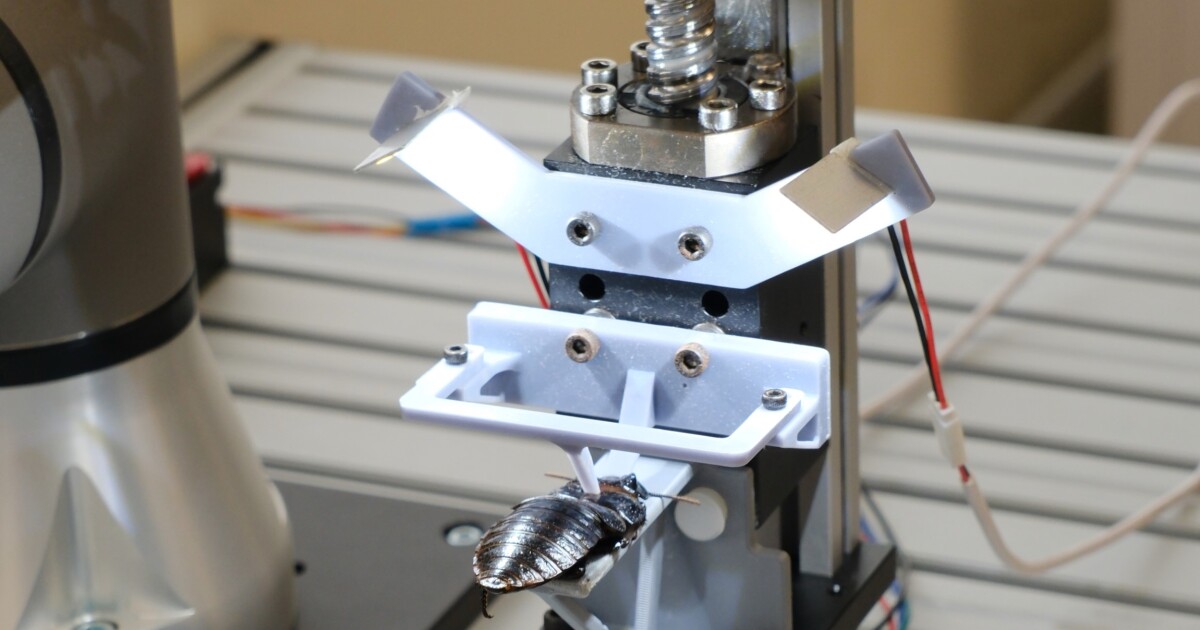
In order to make such technology practical and feasible, the cockroaches can't be painstakingly converted by hand … they need to be cranked out quickly via an automated process. That's where the assembly line comes in.Development of the assembly line (pictured) was supported by the Japan Science and Technology AgencyNanyang Technological UniversityDeveloped by Prof.
Hirotaka Sato and colleagues at Singapore's Nanyang Technological University, the computer-controlled system incorporates a platform for holding the insect in place, an Intel RealSense depth-sensing camera, and a UR3e robotic arm with a Hand-E robotic gripper.After an anesthetized cockroach is secured on the platform, a motor slides that rig into position, and a computer vision system assesses the insect's body size and position.
One section of the cockroach's outer cuticle is then pulled back, revealing a membrane between its pronotum and mesothorax body segments.Next, a preassembled 2.3-gram backpack is lowered down onto the insect, and two bipolar electrodes at the front of that pack are implanted into the left and right sides of the exposed membrane.
The main backpack is then gently pressed down onto the cockroach's mesothorax until it latches into place. In a final step, the platform slides back out, and the still-anesthetized insect is released.A diagram of the assembly line and the cyborg cockroaches – manually-assembled cyborgs have already been field-tested in Myanmar, in the aftermath of a 7.
7-magnitude earthquakeNanyang Technological UniversityThe whole process takes 68 seconds per cockroach, as compared to anywhere from 15 minutes to an hour when performing the same task by hand. And in tests performed on assembly-line and manually-assembled cyborg cockroaches, both groups were found to perform similarly in remote-control tasks such as following an S-shaped path and exploring obstructed terrain.
As an added bonus for the insects (and for the backpacks' batteries), this particular cyborg setup requires only 40% of the stimulation time and 75% of the stimulation voltage used in similar systems. And yes, the backpack can be removed between missions."Our innovation makes the dream of deploying large numbers of cyborg insects in real-life scenarios far more practical," says Sato.
"By automating the process, we can produce insect-hybrid robots rapidly and consistently. It will allow us to prepare them in large numbers, which will be critical in time-sensitive operations such as post-disaster search and rescue."A paper on the research was recently published in the journal Nature Communications.
Source: Nanyang Technological University
Source coverage
Report Provider: New Atlas
Author: Nanyang Technological University
Deeper analysis
Full source content
Instead of going to the time and trouble of designing and building tiny robots from scratch, some scientists are now turning existing insects into remote-control cyborgs. A new "assembly line" could help, by converting cockroaches into cyborgs far faster than can be done by hand.Putting it simply, cyborg insects typically consist of a large-ish insect – often a Madagascar hissing cockroach – that has been equipped with a small electronic backpack.
Remotely controlled electrodes in that backpack stimulate body parts such as the insect's antennae or eyes, causing it to start and stop walking, and turn left or right.And no, the whole thing isn't just an exercise in morbid curiosity.One of the main proposed uses for such cyborgs is searching for survivors trapped under rubble at disaster sites.
A remote-control camera-equipped cockroach could squeeze through otherwise-impassable gaps in the debris, transmitting live images and the coordinates of any survivors it comes across.A cyborg cockroach developed at North Carolina State UniversityEric WhitmireFor such a large-scale task, however, just a few cyborg cockroaches wouldn't suffice.
It is envisioned that large groups of the insects would be deployed throughout the rubble, possibly even coordinating their search routes via wireless communication between their backpacks. If the routes of two cyborgs were overlapping, for instance, their backpacks could steer them apart from one another.
In order to make such technology practical and feasible, the cockroaches can't be painstakingly converted by hand … they need to be cranked out quickly via an automated process. That's where the assembly line comes in.Development of the assembly line (pictured) was supported by the Japan Science and Technology AgencyNanyang Technological UniversityDeveloped by Prof.
Hirotaka Sato and colleagues at Singapore's Nanyang Technological University, the computer-controlled system incorporates a platform for holding the insect in place, an Intel RealSense depth-sensing camera, and a UR3e robotic arm with a Hand-E robotic gripper.After an anesthetized cockroach is secured on the platform, a motor slides that rig into position, and a computer vision system assesses the insect's body size and position.
One section of the cockroach's outer cuticle is then pulled back, revealing a membrane between its pronotum and mesothorax body segments.Next, a preassembled 2.3-gram backpack is lowered down onto the insect, and two bipolar electrodes at the front of that pack are implanted into the left and right sides of the exposed membrane.
The main backpack is then gently pressed down onto the cockroach's mesothorax until it latches into place. In a final step, the platform slides back out, and the still-anesthetized insect is released.A diagram of the assembly line and the cyborg cockroaches – manually-assembled cyborgs have already been field-tested in Myanmar, in the aftermath of a 7.
7-magnitude earthquakeNanyang Technological UniversityThe whole process takes 68 seconds per cockroach, as compared to anywhere from 15 minutes to an hour when performing the same task by hand. And in tests performed on assembly-line and manually-assembled cyborg cockroaches, both groups were found to perform similarly in remote-control tasks such as following an S-shaped path and exploring obstructed terrain.
As an added bonus for the insects (and for the backpacks' batteries), this particular cyborg setup requires only 40% of the stimulation time and 75% of the stimulation voltage used in similar systems. And yes, the backpack can be removed between missions."Our innovation makes the dream of deploying large numbers of cyborg insects in real-life scenarios far more practical," says Sato.
"By automating the process, we can produce insect-hybrid robots rapidly and consistently. It will allow us to prepare them in large numbers, which will be critical in time-sensitive operations such as post-disaster search and rescue."A paper on the research was recently published in the journal Nature Communications.
Source: Nanyang Technological University
How this page is built
Goose Pod turns cited reporting into a public episode summary first, then pairs that summary with audio playback so listeners can check the source material before they decide how deeply to engage.
The goal is to make this page useful as a news landing page first, while still giving listeners transcript access, related episodes, and direct links back to the original publishers.