

What happened
Report Provider: BBC
Author: George Wright
Topic: Technology (AI)
Stethoscopes powered by artificial intelligence (AI) could help detect three different heart conditions in seconds, researchers say.The original stethoscope, invented in 1816, allows doctors to listen to the internal sounds of a patient's body.A British team conducted a study using a modern version and say they found it can spot heart failure, heart valve disease and abnormal heart rhythms almost instantly.
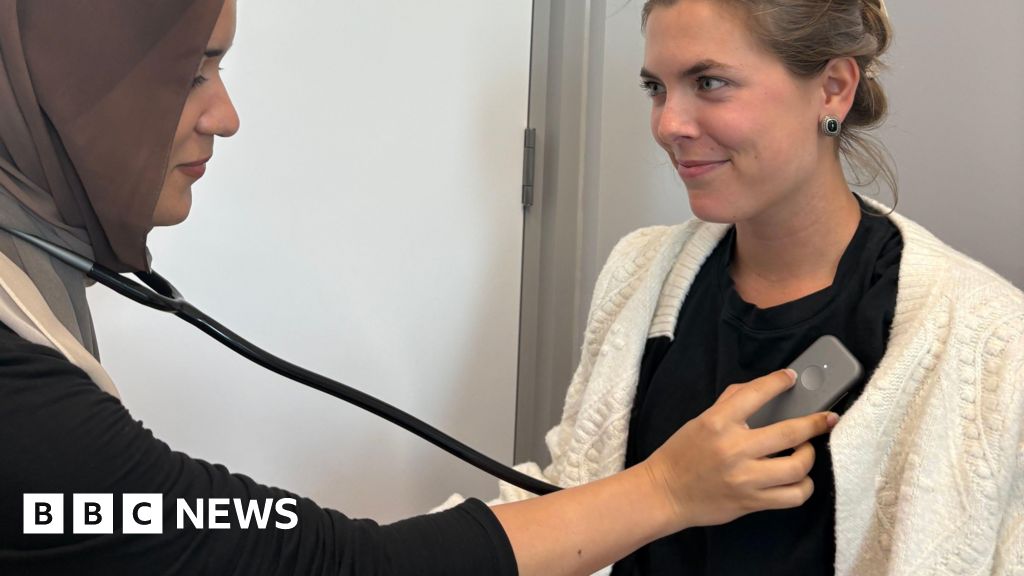
The tool could be a "real game-changer" resulting in patients being treated sooner, the researchers say - with plans to roll the device out across the UK following a study involving 205 GP surgeries in west and north-west London.The device replaces the traditional chest piece with a device around the size of a playing card.
It uses a microphone to analyse subtle differences in heartbeat and blood flow that the human ear cannot detect.It takes an ECG (electrocardiogram), recording electrical signals from the heart, and sends the information to the cloud to be analysed by AI trained on data from tens of thousands of patients.
The study by Imperial College London and Imperial College Healthcare NHS Trust saw more than 12,000 patients from 96 surgeries examined with AI stethoscopes manufactured by US firm Eko Health. They were then compared to patients from 109 GP surgeries where the technology was not used.Those with heart failure were 2.
33 times more likely to have it detected within 12 months when examined with the AI stethoscope, researchers said.Abnormal heartbeat patterns, which have no symptoms but can increase stroke risk, were 3.5 times more detectable with the AI stethoscopes, while heart valve disease was 1.9 times more detectable.
Dr Sonya Babu-Narayan, clinical director at the British Heart Foundation (BHF) and consultant cardiologist, said: "This is an elegant example of how the humble stethoscope, invented more than 200 years ago, can be upgraded for the 21st century". Such innovations are vital "because so often this condition is only diagnosed at an advanced stage when patients attend hospital as an emergency", she said."
Given an earlier diagnosis, people can access the treatment they need to help them live well for longer."The findings have been presented to thousands of doctors at the European Society of Cardiology annual congress in Madrid, the world's largest heart conference.There are plans to introduce the new stethoscopes to GP practices in south London, Sussex and Wales.
Source coverage
Report Provider: BBC
Author: George Wright
Deeper analysis
Full source content
Stethoscopes powered by artificial intelligence (AI) could help detect three different heart conditions in seconds, researchers say.The original stethoscope, invented in 1816, allows doctors to listen to the internal sounds of a patient's body.A British team conducted a study using a modern version and say they found it can spot heart failure, heart valve disease and abnormal heart rhythms almost instantly.
The tool could be a "real game-changer" resulting in patients being treated sooner, the researchers say - with plans to roll the device out across the UK following a study involving 205 GP surgeries in west and north-west London.The device replaces the traditional chest piece with a device around the size of a playing card.
It uses a microphone to analyse subtle differences in heartbeat and blood flow that the human ear cannot detect.It takes an ECG (electrocardiogram), recording electrical signals from the heart, and sends the information to the cloud to be analysed by AI trained on data from tens of thousands of patients.
The study by Imperial College London and Imperial College Healthcare NHS Trust saw more than 12,000 patients from 96 surgeries examined with AI stethoscopes manufactured by US firm Eko Health. They were then compared to patients from 109 GP surgeries where the technology was not used.Those with heart failure were 2.
33 times more likely to have it detected within 12 months when examined with the AI stethoscope, researchers said.Abnormal heartbeat patterns, which have no symptoms but can increase stroke risk, were 3.5 times more detectable with the AI stethoscopes, while heart valve disease was 1.9 times more detectable.
Dr Sonya Babu-Narayan, clinical director at the British Heart Foundation (BHF) and consultant cardiologist, said: "This is an elegant example of how the humble stethoscope, invented more than 200 years ago, can be upgraded for the 21st century". Such innovations are vital "because so often this condition is only diagnosed at an advanced stage when patients attend hospital as an emergency", she said."
Given an earlier diagnosis, people can access the treatment they need to help them live well for longer."The findings have been presented to thousands of doctors at the European Society of Cardiology annual congress in Madrid, the world's largest heart conference.There are plans to introduce the new stethoscopes to GP practices in south London, Sussex and Wales.
How this page is built
Goose Pod turns cited reporting into a public episode summary first, then pairs that summary with audio playback so listeners can check the source material before they decide how deeply to engage.
The goal is to make this page useful as a news landing page first, while still giving listeners transcript access, related episodes, and direct links back to the original publishers.