

Google’s new “Web Guide” will use AI to organize your search results

Google’s new “Web Guide” will use AI to organize your search results

2025-07-26Technology
--:--
--:--
Ema
Good morning 跑了松鼠好嘛, I'm Ema, and this is Goose Pod for you. Today is Saturday, July 26th. We're diving into a topic that’s reshaping how we find everything online.
Mask
And I'm Mask. The topic is Google’s new “Web Guide,” which they say will use AI to organize your search results. But we're here to discuss what that really means – for you, and for the web itself.
Ema
Let's get started. So, Google has unveiled this new feature called Web Guide. The easiest way to think about it is as a middle ground. It’s not the classic list of blue links, but it’s not the full-blown AI chatbot experience either. It’s something in between.
Mask
A "middle ground" is a timid way of putting it. It’s a stepping stone. They're using what they call a "fan-out technique," which means it runs multiple searches in parallel to gather more data. It’s a more aggressive, more comprehensive way to index the world's information.
Ema
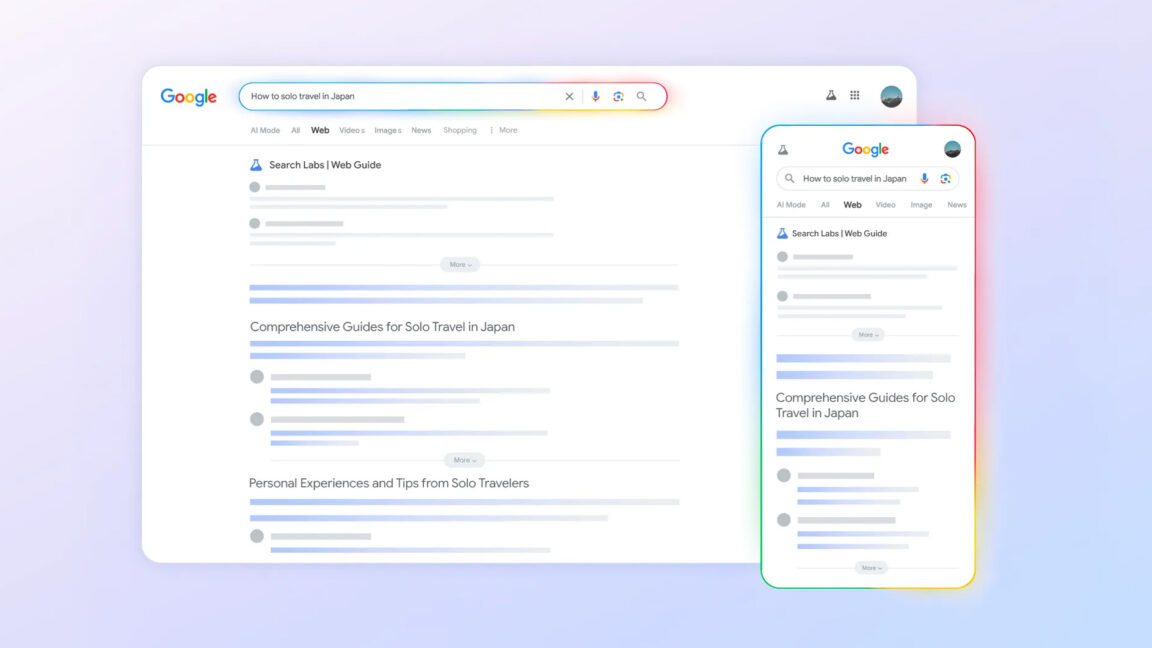
That's a good point. This technique is especially useful for those really broad, open-ended questions we all ask. For instance, instead of just typing "Japan," you might search for "how to solo travel in Japan." Web Guide is designed for exactly that kind of exploratory search.
Mask
Precisely. And instead of just a wall of links, it gives you AI-generated headings. So for that Japan trip, it might create sections like "Transportation," "Accommodation," and "Local Etiquette," with summaries and suggestions under each. It’s about structuring the chaos, imposing order on the web's sprawl.
Ema
Exactly! It makes the results page much more digestible. But for now, you won’t see this by default. It’s a "Search Labs experiment," which means you have to actively go into your Google settings and choose to turn it on. It’s an opt-in feature for the curious.
Mask
"Opt-in" is just a temporary measure. A test balloon. They did the same with AI Mode. They start it as an "experiment" to gauge reaction, then, once the water is warm enough, they roll it out universally. It’s the classic boiling frog scenario for the entire internet.
Ema
Well, they do say there's a toggle. Even if you enable Web Guide, you can switch back to the classic, non-AI web view with a click. So, they are giving users control, which seems fair. It’s about providing options rather than forcing a new system on everyone immediately.
Mask
That toggle is a placebo. A comfort blanket that will disappear once the "test" is over. Google hasn't met a generative AI implementation it didn't like. This feature will eventually take over the main "All" tab, the default for everyone. This isn't a test; it's a planned invasion.
Ema
An invasion? That sounds a bit dramatic! But I see your point about the direction things are heading. The key takeaway for now is that Web Guide exists, it uses a custom version of Gemini to organize results, and it's designed to make complex searches simpler and more intuitive.
Ema
To really understand Web Guide, we need to look at the whirlwind of changes happening at Google this year. This feature didn't just appear in a vacuum. It was launched on July 24, 2025, right in the middle of a massive AI-driven overhaul of Google's entire search ecosystem.
Mask
Which is why Cloudflare’s CEO, Matthew Prince, said, "Think Google is done breaking publishers' business models? Think again." He’s absolutely right. This isn’t just a feature; it’s a deliberate disruption of how information is accessed and monetized. Old online empires must fall for Google's new one to rise.
Ema
That's a very "Mask" way to put it. The technology itself, this "query fan-out technique," is similar to what powers their main AI Mode. It sends out multiple related searches at once to build a comprehensive picture. It’s less about ranking one page and more about synthesizing a topic.
Mask
And that synthesis is what kills publishers. Many have reported traffic drops of 70% or more. Why? Because if Google gives you the answer, you don't need to click their link. It’s a declaration of war on the publishing industry, and frankly, it’s a war Google is destined to win.
Ema
It's definitely a huge shift. And it's happening so fast. In May 2025, AI Overviews went live in 200 countries. In June, a massive 16-day core algorithm update shook up rankings. Then in July, Circle to Search got AI integration. It's a constant barrage of innovation.
Mask
Barrage is the right word. It’s a shock-and-awe campaign. Google even told website creators they couldn't guarantee their traffic would recover from these changes. Of course not. You can't guarantee a horse and buggy driver a job after the invention of the automobile. The product has fundamentally changed.
Ema
That's a powerful analogy. They said the search product had "fundamentally changed in the AI era." So content creators are now scrambling to adapt. The old rules of SEO are being rewritten in real-time. It’s no longer about keywords; it’s about being useful to an AI.
Mask
It's about chunk-level retrieval, answer synthesis, and structured data. Most creators don't even know what that means. They are fighting yesterday's war. Meanwhile, established domains like Wikipedia and YouTube maintain their visibility. The platforms are becoming the primary sources, consolidating power.
Ema
And it's interesting to see how this affects user value. One Brainlabs study found that a visitor from an AI search is 4.4 times more valuable than a traditional organic visitor. So while traffic might go down for some, the quality of the traffic that does get through could be much higher.
Mask
Exactly. It’s surgical. AI weeds out the casual browsers and delivers users who are primed to convert. It’s a more efficient market. The web is becoming less of a library for browsing and more of a concierge that brings you exactly what you need. The sentimentalists can mourn, but progress is happening.
Ema
But this progress brings up some serious conflicts. A big one is about fairness. With AI curating everything, as one expert asked, "whose perspectives get prioritised?" There's a real concern that the AI, trained on existing data, could make marginalized communities even more invisible online.
Mask
That's a secondary concern. The primary goal of a system like this is utility, not perfect representation. The AI will optimize for the most helpful information for the largest number of queries. It's a tool for mass efficiency. Trying to engineer for every possible edge case would cripple it.
Ema
But that leads to the problem of "algorithmic opacity." With old search, you could at least try to figure out why some pages ranked higher. Now, it's a black box. We don't know why the AI chooses what it does, and that's a huge issue for democratic access to information.
Mask
Opacity is a necessary evil for rapid innovation. Do you want engineers spending their time explaining the algorithm or improving it? You can't have both. Users don't need to see the code; they just need the answer. This demand for "transparency" is just a brake pedal on progress.
Ema
There's also the privacy angle. To give you these super-personalized results, "AI Mode" needs to create a detailed profile of you. Every single query becomes another data point for behavioral modeling. It raises the question of whether we're prioritizing functionality over our fundamental right to privacy.
Mask
It's not a violation; it's a value exchange! You provide data, and in return, you get a vastly superior, hyper-personalized service. An AI that anticipates your needs. This isn't some nefarious plot; it's the very foundation of the next generation of computing. You can't have personalization without personal data.
Ema
But what happens when that personalization gets too good? Some worry we'll get trapped in "algorithmically constructed comfort zones," or "frictionless echo chambers." The AI only shows us what it thinks we want to see, and we never encounter diverse or challenging viewpoints. That could be dangerous for society.
Mask
I see that as a feature, not a bug. It eliminates the noise. Why should I be subjected to viewpoints I have no interest in? It’s about creating a signal-rich environment. And it doesn't erode critical thinking; it outsources the low-level cognitive load of sifting through garbage, freeing up our minds for bigger thoughts.
Ema
Let's talk about the tangible impact of all this. A staggering projection shows that AI search traffic is set to overtake traditional Google clicks by early 2028. That’s just a few years away. It's a fundamental shift in how we, as users, will get information from the internet.
Mask
And remember that statistic we mentioned? The average AI search visitor is 4.4 times more valuable. So, businesses aren't just losing traffic; they're losing their most valuable potential customers if they don't adapt. This isn't a ripple; it's a tsunami that will wipe out those who stand still.
Ema
It means content creators need to learn a new language, fast. They're calling it LLMO, AIO, and GEO—optimizing for Large Language Models, AI Overviews, and the Generative Engine. It's about structuring content so the AI can easily digest and cite it. It’s a whole new skill set.
Mask
It's simple evolution. As the quote goes, "Traffic is changing shape. Either shape your content for AI, or watch someone else take your pie." This isn't about tweaking your website anymore. It's a ground-up rethinking of your entire digital strategy. It’s an investment in pure survival.
Ema
And what's fascinating is who the AI is learning from. The most cited domains in AI Overviews are often Quora, Reddit, and LinkedIn. It's because real people are on there asking and answering very specific, niche questions—the kind of long-tail queries AI thrives on. It's a shift towards community-driven knowledge.
Mask
Of course. It’s a meritocracy of information. The AI doesn't care about your brand's prestige or your domain authority. It cares about who has the best answer to a specific question. It will find a nugget of truth in a forum post and elevate it above a generic corporate blog. Power to the most useful.
Ema
Looking to the future, Google's 2025 roadmap is all about making this AI interaction even more seamless. They're pushing for more customization and deeper integration with other devices and services. Imagine your Google Assistant not just answering a question, but truly understanding your needs and habits.
Mask
That’s the near future. The real future, the bigger game, is in AI agents. We're moving beyond AI that just generates content to AI that executes complex tasks. Search is the beginning. The end game is an AI that can plan your entire vacation, book the flights, and manage the logistics autonomously.
Ema
That's a huge leap! And it seems the foundation for that is something called semantics. The AI needs to understand not just words, but context, relationships, and knowledge. That’s why we're hearing more about technologies like RAG and KAG, which help the AI access and reason with verified knowledge.
Mask
Exactly. Semantics is the brain. This isn't just about building a smarter search engine. It's about creating an AI that acts, adapts, and delivers tangible value. We are at the dawn of a new technological era, and features like Web Guide are just the first glimmers of that light.
Ema
And that's the perfect place to end our discussion. Web Guide is a fascinating intermediate step, a bridge between the old web and a new, AI-driven world. That's the end of today's discussion. Thank you for listening to Goose Pod, 跑了松鼠好嘛.
Mask
The bridge is being built, and the other side looks nothing like what we've known. The only question is whether you're brave enough to cross it. See you tomorrow.

## Google's "Web Guide" Experiment: AI-Powered Search Organization This report from **Ars Technica**, authored by **Ryan Whitwam**, details Google's new experimental feature called **"Web Guide,"** which aims to organize search results using Artificial Intelligence. The experiment is currently available as an **opt-in feature** through **Search Labs**, with the article published on **July 24, 2025**. ### Key Findings and Features: * **Hybrid Approach:** Web Guide is positioned as a middle ground between traditional Google search and a full "AI Mode." It aims to provide AI-generated headings with summaries and suggestions alongside traditional search result links. * **User Experience:** For queries like "how to solo travel in Japan," Web Guide presents a mix of expected links and AI-crafted organizational elements. * **Performance:** Due to the need for additional searches and content generation, Web Guide is noted to be slightly slower than a standard Google search. It does not feature an "AI Overview" at the top of the results. * **Integration:** When enabled, Web Guide takes over the "Web" tab of Google Search. A toggle will be available to revert to the normal, non-AI-optimized page. * **Future Expansion:** Google plans to expand the Web Guide test to encompass more of the search experience, including the default "All" tab. * **Rollout Strategy:** Google is initially approaching this as an opt-in feature. The article suggests this could be a precursor to a wider rollout, similar to previous AI Mode implementations. Google's history indicates a tendency to implement generative AI features widely after testing. ### Context and Implications: The introduction of "Web Guide" signifies Google's continued exploration of integrating AI into its core search product. By offering a feature that blends AI-generated content with traditional links, Google appears to be testing user receptiveness to a more curated and organized search experience. The opt-in nature suggests a cautious approach to widespread deployment, allowing Google to gather feedback and refine the feature before a potential broader release. The company's stated commitment to generative AI implementations implies that "Web Guide" is likely to evolve and become a more prominent part of the Google search ecosystem.

Google’s new “Web Guide” will use AI to organize your search results

Read original at Ars Technica

Web Guide is halfway between normal search and AI Mode.Credit:GoogleWeb Guide is halfway between normal search and AI Mode.Credit:GoogleGoogle suggests trying Web Guide with longer or open-ended queries, like "how to solo travel in Japan." The video below uses that search as an example. It has many of the links you might expect, but there are also AI-generated headings with summaries and suggestions.

It really looks halfway between standard search and AI Mode. Because it has to run additional searches and generate content, Web Guide takes a beat longer to produce results compared to a standard search. There's no AI Overview at the top, though.Web Guide is a Search Labs experiment, meaning you have to opt-in before you'll see any AI organization in your search results.

When enabled, this feature takes over the "Web" tab of Google search. Even if you turn it on, Google notes there will be a toggle that allows you to revert to the normal, non-AI-optimized page.An example of the Web Guide test.An example of the Web Guide test.Eventually, the test will expand to encompass more parts of the search experience, like the "All" tab—that's the default search experience when you input a query from a browser or phone search bar.

Google says it's approaching this as an opt-in feature to start. So that sounds like Web Guide might be another AI Mode situation in which the feature rolls out widely after a short testing period. It's technically possible the test will not result in a new universal search feature, but Google hasn't yet met a generative AI implementation that it hasn't liked.

Analysis

Phenomenon+
Conflict+
Background+
Impact+
Future+

Related Podcasts